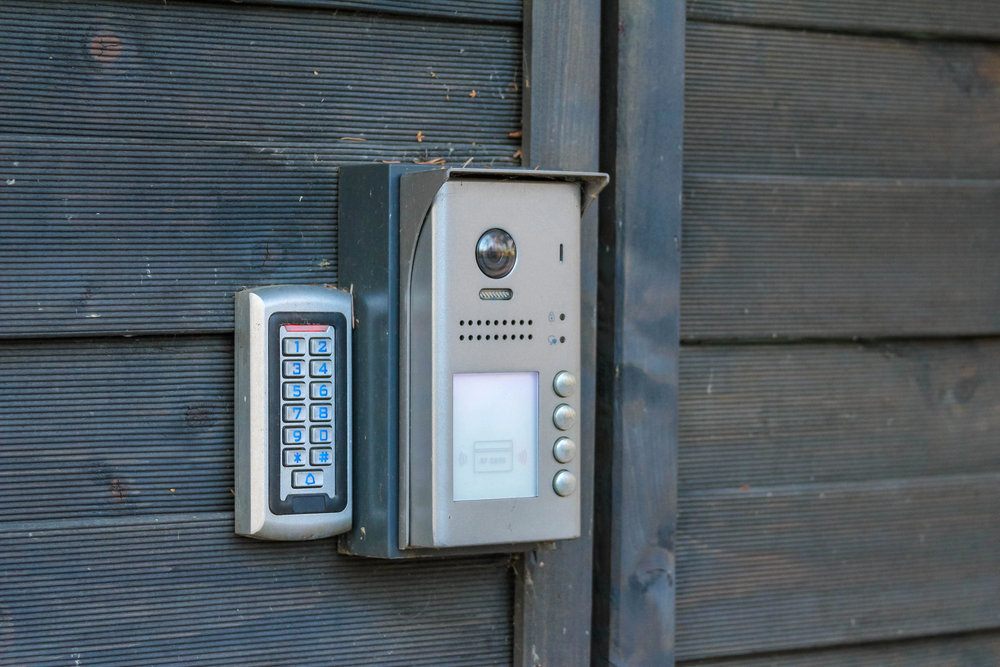
For decades, the security of a residential community was resolved with a lock, an intercom, and at most, a camera at the entrance. Today, the scenario is very different: access control in buildings has become a connected ecosystem that combines smart intercoms, remote management from a mobile device, home automation, and a telecommunications infrastructure capable of supporting all this. For property managers and community presidents, understanding this transformation is no longer a matter of the future, but of daily management.
From Traditional Intercom to Smart Intercom
The classic intercom model was based on an external panel with buttons and an intercom in each home, whose only function was to allow voice communication and remotely open the door. Telecommunications specialists have been replacing these systems for years with IP video intercoms and smart solutions that add visual identification, mobile notifications, and integration with other building security systems.
The difference is not just aesthetic. If the priority is community protection and thorough access control, the video intercom is the most recommended option for its visual identification capability, and for those seeking convenience and remote access management, it offers features that the traditional intercom cannot match. Additionally, many current systems already allow for add-ons such as vandal-proof panels, concierge centers that filter calls before passing them to residents, or additional cameras at other points in the building.
Access Control in Buildings: Beyond the Street Panel
The real qualitative leap comes with smart access control systems, designed to replace keys and cards with digital solutions. This model, known as PropTech applied to residential security, changes the traditional approach: the traditional security model in communities is mainly passive, based on locks, doors, and intercoms, while smart solutions focus on active management.
Among the functionalities that are already becoming standard in communities are:
Real-time control, remote management, immediate removal of unauthorized access, and entry history.
Opening via mobile app, code, or proximity, without the need to duplicate physical keys.
Integration with video intercoms and cameras to verify who accesses the building at any time.
Automations according to schedules, useful for garages, storage rooms, or common areas with restricted use.
This change also has a significant economic impact on the community: the direct impact on operating costs is noticeable in the reduction of key copies, lock changes, travel, management time, and incidents. And, contrary to what many homeowners' associations imagine, since it does not require construction or large installations, the initial investment is usually manageable and the return, in many cases, is immediate.
Home Automation in Communities: Security as Part of an Integral System
Home automation is no longer limited to individual housing: more and more communities are incorporating automation in common areas, garages, and alarm systems. One of the most recurring functions of home automation in communities is to ensure security, incorporating tools to intelligently manage building alarms, presence simulators, video security, smart video intercoms, or surveillance cameras controlled by streaming, as well as reinforcing security in the community garage.
At the building level, automation is also advancing towards efficiency and anticipation. AI applied to buildings has made a qualitative leap: it is no longer about programming schedules, but about predictive learning profiles that analyze thermal behavior, actual occupancy, and weather forecasts. In communities with complex electrical and HVAC installations, standards like KNX continue to be a reference because they guarantee interoperability between manufacturers and their stability against cyberattacks, positioning themselves as the gold standard of professional automation.
Fiber Optics: The Foundation Supporting the Entire Connected Building
No access control system, smart video intercom, or home automation works without an adequate telecommunications infrastructure. Here it is worth remembering some regulatory nuances that often generate doubts in homeowners' associations. The installation of fiber optics in residential communities is governed by the General Telecommunications Law and Royal Decree 346/2011, which recognize the right of owners to receive telecommunications services as long as the necessary technical conditions are met and no damage is caused to the building's property.
Although there is no obligation to switch to fiber, telecommunications operators must provide fiber optic services to users who request it, as long as it is technically possible and does not cause damage to common property. Additionally, the installation does not require municipal or regional permits, although it is advisable to communicate it to the corresponding autonomous community through a responsible declaration. Having an updated ICT infrastructure is precisely what allows the subsequent installation of IP intercoms, connected cameras, or home automation systems that require stable bandwidth without friction.
How to Make the Leap Without Complicating Community Management
The digitalization of security should not involve invasive works or hasty decisions in the assembly. Some practical recommendations for administrators and community presidents:
First audit the state of the wiring and ICT infrastructure before deciding which access control or smart intercom system to install.
Prioritize scalable solutions that allow adding cameras, access control, or home automation progressively and without large initial outlays.
Consider medium-term operational savings (fewer incidents, fewer lock changes) against the initial cost.
Compare several technical quotes before submitting the proposal to a vote, especially if integrating various subsystems (access, video, home automation).
At ForConnect, we help property managers and communities find specialized professionals in telecommunications, access control, home automation, and fiber optics, verified and adapted to each type of building. You can consult the trusted professionals directory or, if you already have a clear project that your community wants to tackle, request a quote and compare options without obligation.