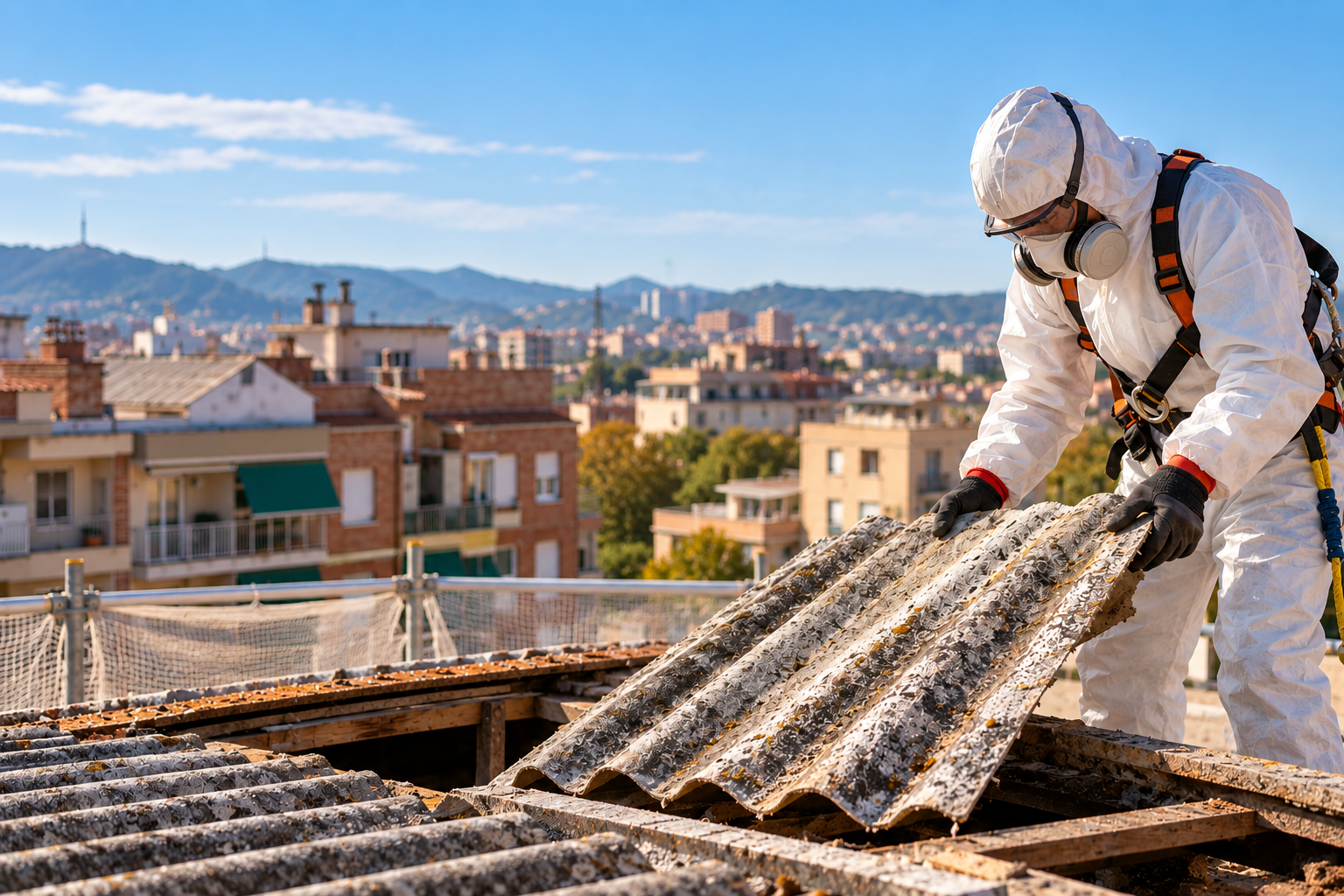
Roofs, downspouts, tanks, and other fiber cement elements installed decades ago remain present in many Catalan buildings. For years they may have gone unnoticed, but the management and removal of asbestos have become even more important with the approval of the Law 8/2026, of July 2, on the eradication of asbestos in Catalonia.
For property managers and homeowners' associations, it is especially advisable to identify possible asbestos-containing materials and incorporate them into the building's maintenance and rehabilitation planning. Anticipating allows for assessing the condition of the elements, studying necessary actions, and avoiding having to make hasty decisions when a breakdown occurs or work begins.
Where can asbestos be found in a homeowners' association?
Asbestos was used for decades in construction for its insulating, mechanical, and heat-resistant properties. In Spain, its use and commercialization were definitively banned in 2002.
One of the most well-known materials is asbestos-containing fiber cement, often popularly identified with the name 'uralita'.
According to the Catalan Waste Agency, asbestos can be present in different construction elements. In residential buildings, it is especially important to review old elements such as fiber cement roofs, downspouts, tanks, or planters, among others.
Therefore, before intervening on a roof, replacing old installations, or starting certain rehabilitation works, it is advisable to check what materials are actually in the building.
Why is it important to monitor the condition of asbestos?
The mere presence of an asbestos-containing material should not be managed in the same way as a situation where this material is deteriorated or manipulated.
The risk arises especially when asbestos fibers can be released into the environment and inhaled. Exposure to these fibers is related to serious diseases, such as asbestosis, mesothelioma, and certain types of cancer.
In Catalonia, moreover, the magnitude of the problem is considerable. The National Plan for the Eradication of Asbestos indicates the existence of a very high amount of fiber cement pending removal and establishes a strategy to progressively advance towards an asbestos-free territory.
For a community, the best strategy is not necessarily to wait for an incident to occur. Knowing what elements exist and their condition facilitates planning future actions for the building.
What does the new Law 8/2026 on asbestos in Catalonia entail?
The Law 8/2026, of July 2, on the eradication of asbestos in Catalonia, establishes a specific framework to advance in the identification, control, management, and progressive removal of asbestos-containing materials.
The regulation is part of the Catalan strategy for the eradication of asbestos. The National Plan for the Eradication of Asbestos in Catalonia 2023-2032 sets the horizon to eliminate asbestos from public buildings before 2028 and from the entire territory by 2032.
This does not mean that all communities must immediately execute the same action. The applicable obligations and actions must be assessed based on each specific situation and the current regulations.
However, it reinforces the need for owners, managers, and building officials to know if asbestos-containing materials exist and to adequately plan their management.
What should a community do if it suspects it has asbestos?
The first thing not to do is manipulate, drill, cut, or break a suspicious material to personally check if it contains asbestos.
Faced with an element likely to contain it, it is advisable to have a professional assessment and determine what type of action is appropriate.
In general terms, a community can structure the process in several phases:
Locate the suspicious elements.
Determine if they contain asbestos using appropriate procedures.
Assess their condition and characteristics.
Determine if intervention is necessary and how to do it.
Request an appropriate technical and economic proposal.
Coordinate the removal and proper management of waste when applicable.
This planning is especially important when the action is part of a larger project, such as the rehabilitation of a roof or the replacement of old installations.
Who can remove asbestos from a building?
The removal of asbestos should not be treated as a conventional work.
The intervention is subject to specific occupational risk prevention and waste management requirements. Among other issues, companies carrying out activities or operations where their workers are exposed or may be exposed to asbestos fibers must comply with the applicable regulations and the corresponding requirements of the Register of Companies at Risk of Asbestos (RERA).
Therefore, when a community compares proposals, price should not be the only criterion.
It is necessary to review exactly what each budget includes: preliminary work, removal, auxiliary means, transport, waste treatment, replacement of removed elements, and other necessary actions.
This comparison avoids later encountering items that were not initially considered.
Are there grants for asbestos removal in Catalonia?
Catalonia has promoted different calls for grants aimed at encouraging the removal of asbestos-containing materials.
The Catalan Waste Agency announced in 2026 a line endowed with 10.5 million euros, of which 8.5 million were allocated to a line that included, among potential beneficiaries, individuals, homeowners' associations, companies, freelancers, and non-profit organizations.
This call established a maximum of 30,000 euros per property and its application deadline ended on July 2, 2026.
This information is important because a grant found on the Internet may correspond to a call that is already closed. Before calculating the final cost of an intervention, it is always necessary to check if there are new open calls through the official channels of the Generalitat and the Catalan Waste Agency.
Can removing asbestos be the time to rehabilitate the building?
In certain cases, yes.
When asbestos is part of a roof that needs to be removed, for example, the community can take advantage of the intervention to simultaneously study the condition of the waterproofing, insulation, and other construction elements.
In this way, a specific need can be integrated into a more comprehensive rehabilitation action.
The same approach is useful when asbestos is found in downspouts or other old installations: before acting, it is advisable to analyze if there are other nearby elements that will also need to be renewed in the short or medium term.
Planning the different actions together can reduce interference between trades, avoid repeating certain tasks, and facilitate a clearer economic forecast for the owners.
The vision of Fresgrup: coordinating different actions in the same project
When the removal of an element is part of a broader rehabilitation, having a company with different specialties can facilitate the coordination of the work.
Fresgrup Obres i Serveis, based in Mollet del Vallès, is a company dedicated to works, renovations, and maintenance that indicates on its website more than 30 years of experience in the sector.
Among the services it offers are community maintenance, renovations, installations, vertical work, facade rehabilitation, patios and roofs, and asbestos removal, among other actions.
This diversity of services is especially interesting when an intervention does not end with the removal of an element, but subsequently requires rehabilitation, replacement, or reconstruction of the affected area.
Their website also indicates that the company can manage licenses, designs, and plans and works with a work contract to previously define aspects such as deadlines, quality, and guarantees.
In any specific action with asbestos, however, the community must ensure that the specific work will be carried out complying with all applicable legal, technical, and preventive requirements, including those related to the RERA when applicable.
Fresgrup and ForConnect
Fresgrup Obres i Serveis is part of the ForConnect professional network, a platform that connects property managers, homeowners' associations, and individuals with companies specialized in different building services.
In an action related to asbestos, planning is especially important: not only should the removal of the material be assessed, but also what will happen afterward with the affected roof, installation, or construction element.
If your community needs a professional specialized in rehabilitation, maintenance, or actions related to asbestos-containing elements, at ForConnect you can find verified companies and request advice or a quote.