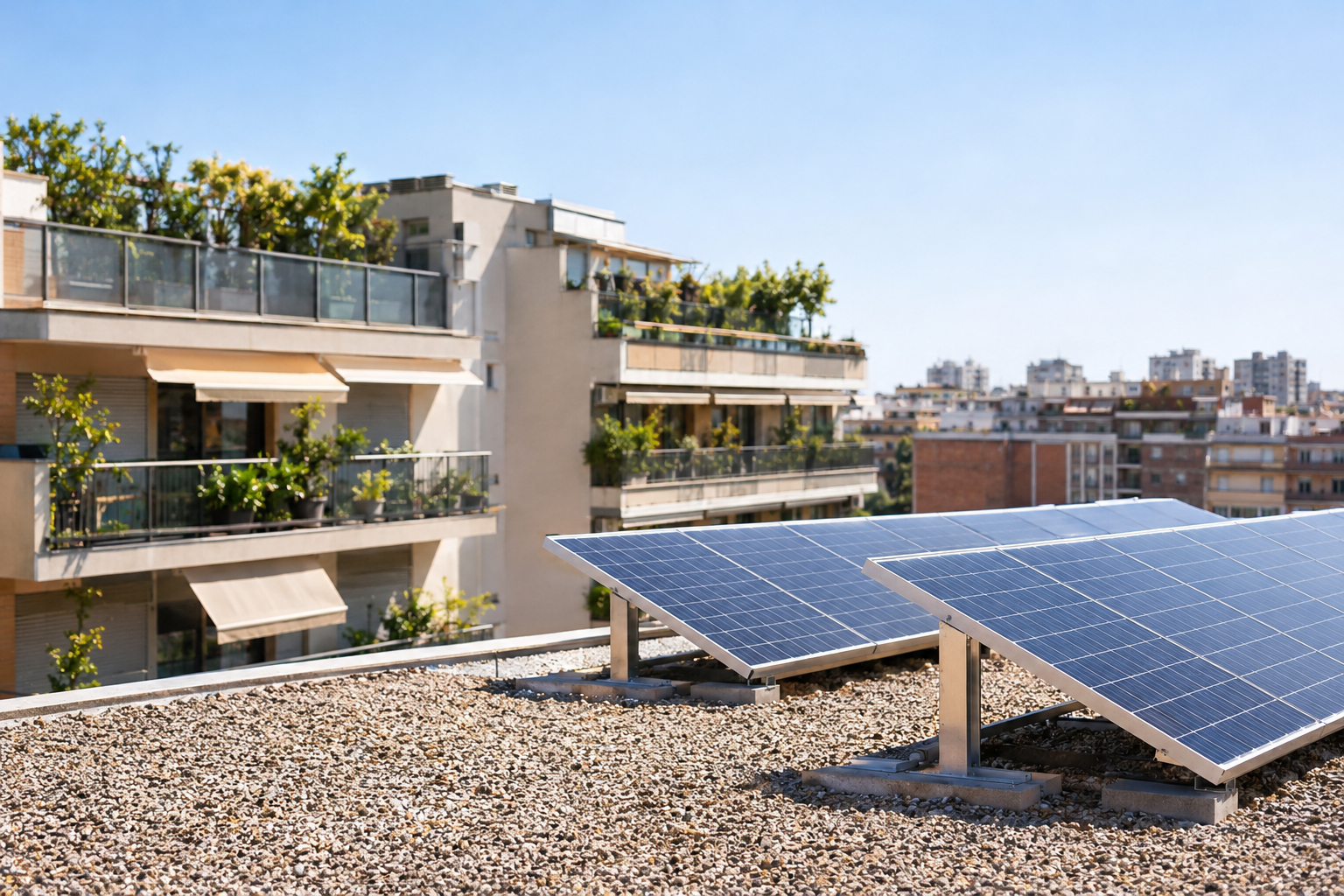
Energy efficiency in homeowner communities is experiencing a moment of acceleration. In recent weeks, the Government has approved new regulations that facilitate collective self-consumption with solar panels and, combined with the advancement of aerothermal energy, are changing the way residential buildings approach their energy transition. If your community is considering installing solar panels on the roof or replacing the central boiler, now is the time to understand what has changed and what opportunities are opening up.
Collective Self-Consumption: The New Framework That Facilitates Sharing Solar Energy
Collective self-consumption allows a building's roof to become a source of shared electricity generation among several neighbors. The new framework arrives with 9.2 GW of self-consumption already installed and 837 energy communities established, with 550,000 households already within the system. This shows that it is not a minority trend but a model that more and more properties are adopting.
Among the most recent developments is that the text especially facilitates shared self-consumption, allowing collective projects in homeowner communities, neighborhoods, towns, or industrial areas, even if participants do not have their own roofs to install their own installations. Additionally, the process is simplified: the management of collective self-consumptions is facilitated by allowing registration with the first distribution agreement received by the distributor, and modifications to the distribution agreement only require the signature of the affected consumers. A new modality of shared surpluses is also created, where a consumer only shares their surpluses, encouraging more participation in collective self-consumptions.
Another significant change came months ago: Royal Decree-Law 7/2026 extends the maximum distance for collective self-consumption from 2 to 5 km, creates the figure of the self-consumption manager, and reduces to one-third the majority needed in communities of neighbors to install renewables. In practice, this means that unanimity or high qualified majorities are no longer needed to take the step towards solar panels.
Aerothermal Energy in the Community of Neighbors: Less Consumption, Less Emissions
The other major piece of the puzzle is aerothermal energy, which is consolidating as an alternative to central gas or diesel boilers. In a context marked by energy price volatility and the need to reduce emissions, aerothermal energy is becoming one of the most profitable and sustainable solutions for heating and hot water production in residential buildings. The reason is simple: the community moves from burning fossil fuel to using electricity to power a much more efficient machine, capable of delivering between 3 and 4 thermal kWh for every electrical kWh consumed under suitable conditions.
In terms of savings, in many community aerothermal projects, energy savings are around 30–50%, depending on the climate, schedules, and the condition of the existing installation. This is not a minor fact considering that buildings represent about 40% of the energy consumption of the European Union.
The same legal reform that facilitates collective self-consumption also affects aerothermal energy: since March 22, 2026, a modification of article 17.1 of the Horizontal Property Law is in effect, expressly including aerothermal and geothermal energy within the renewable energy systems contemplated by the regulation. Additionally, the Ministry has strengthened incentives: the proposal triples the computable savings in a block or community of owners and quadruples it when moving from individual boilers to a centralized system for the purposes of Energy Savings Certificates.
Why Combining Solar Panels and Aerothermal Energy Multiplies Savings
When a community installs solar panels in collective self-consumption and, at the same time, replaces its central boiler with aerothermal energy, the result goes beyond the sum of both measures. The electricity generated on the roof can directly power the heat pump that produces heating and hot water, reducing the electricity bill precisely in the most intensive part of the building's consumption. This joint approach aligns with the energy rehabilitation plans that many communities, including in cities like Barcelona, are promoting to improve their rating and protect the property's value against increasingly stringent decarbonization regulations.
What a Community Should Consider Before Taking the Step
- Commission a preliminary technical study that analyzes the building's actual consumption, the roof's orientation, and the condition of the existing thermal installation.
- Verify if the project can benefit from the new shared surpluses modality or requires a traditional distribution agreement.
- Check the current building's energy efficiency certificate, as it marks the starting point and helps prioritize actions with the greatest impact.
- Evaluate whether a centralized aerothermal installation or a hybrid system that maintains the boiler as occasional support is advisable.
- Have professionals who jointly manage the electrical, thermal, and administrative processing with the distributor.
Since the regulatory framework continues to evolve, it is most reasonable to rely on specialists who know both the technical part and the updated procedures. In the ForConnect professional directory, you can find solar energy installers and aerothermal specialists with experience in homeowner communities, capable of accompanying the board from the initial study to commissioning.
The Time to Act is Now
With a regulatory framework that facilitates processing, reduces the necessary majorities in the board, and improves incentives linked to energy savings, many communities are beginning to see collective self-consumption and aerothermal energy not as an expense, but as an investment that pays off with each bill. If your community wants to take the step towards energy efficiency, the first move is to have a clear diagnosis and trusted professionals. You can request a quote at ForConnect and compare proposals tailored to the real needs of your building.