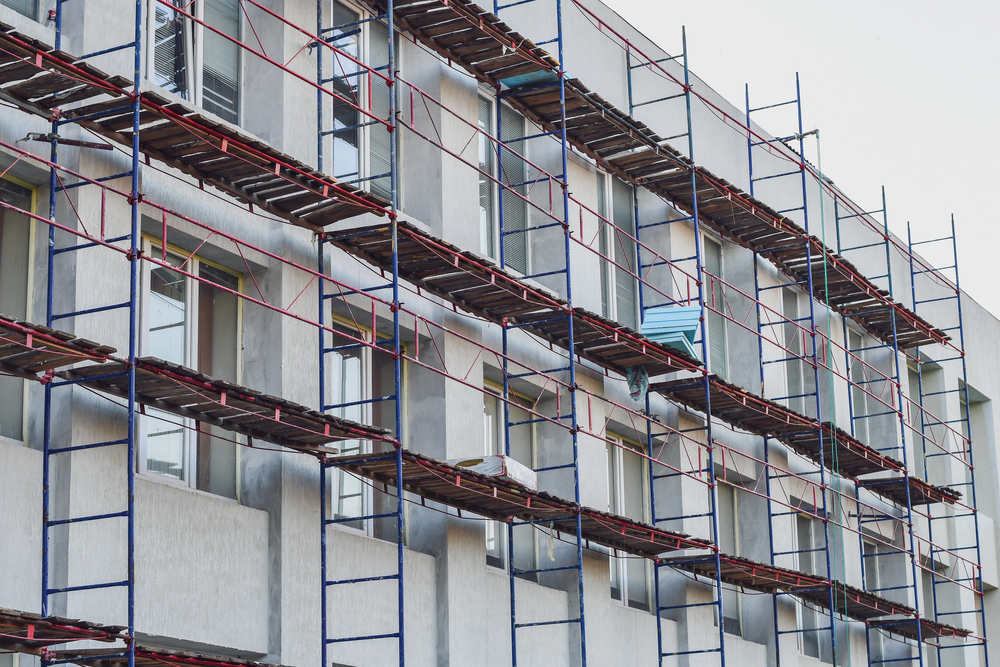
Rehabilitating a building is an important decision, both for the financial investment it represents and for the implications it has on the daily lives of its occupants. When a community of owners or a property owner decides to undertake a comprehensive rehabilitation, it is not enough to choose a construction company and approve a budget.
Good planning, professional coordination, and monitoring of the work are essential factors to avoid delays, control costs, and achieve a satisfactory result.
But what should be considered before starting a comprehensive building rehabilitation?
What does a comprehensive building rehabilitation involve?
Comprehensive rehabilitation involves intervening in different elements of a building to improve its state of conservation, safety, functionality, or energy efficiency.
Unlike a punctual repair, this type of action can simultaneously affect various parts of the property, such as facades, roofs, installations, or the structure.
Among the most common interventions are:
Facade rehabilitation and repair of damages.
Waterproofing and renovation of roofs.
Repair or reinforcement of structural elements.
Renovation of electrical and plumbing installations.
Improvements in accessibility and energy efficiency.
Redistribution and adaptation of interior spaces.
Not all buildings require the same actions. Therefore, before defining the scope of the work, it is important to have a technical assessment that identifies the real needs of the property.
The importance of planning before starting the work
One of the most common mistakes in rehabilitation is starting to make decisions without having defined the project well enough.
When unforeseen problems arise, modifications may be necessary that affect the budget or schedule.
To reduce this risk, it is advisable to work on three fundamental aspects.
1. Knowing the real state of the building
Before starting, it is necessary to study the construction characteristics of the property, its age, and possible pathologies.
In old buildings, for example, there may be issues with moisture, material degradation, or structural deficiencies that are not visible at first glance.
An adequate technical diagnosis helps to establish priorities and determine which interventions are necessary.
2. Defining a detailed budget
The budget should specify the different parts of the work, the planned materials, deadlines, and execution conditions.
It is also advisable to reserve a portion for unforeseen events, especially when working on old buildings, where incidents may arise during execution.
Comparing budgets does not mean automatically choosing the cheapest one. It is important to ensure that all proposals include the same work and offer equivalent guarantees.
3. Establishing a realistic schedule
A comprehensive rehabilitation may involve different teams working on the same building.
If the actions are not well coordinated, a delay in one phase can affect the subsequent ones.
Having a schedule with defined phases facilitates project monitoring and allows anticipating possible problems.
How to avoid cost overruns and delays in rehabilitation?
Unforeseen events cannot always be eliminated, but good organization helps reduce their impact.
One of the most important aspects is communication between all parties involved: ownership, project management, construction company, and specialized professionals.
When everyone works independently, coordination errors, duplications, or contradictory decisions are more likely to occur.
For this reason, management methodologies that seek to optimize construction processes are becoming increasingly prominent.
What is Lean Construction?
Lean Construction is a management methodology applied to construction that aims to improve project efficiency, reduce non-value-adding activities, and make better use of available resources.
In rehabilitation, this approach can help organize the different phases, detect coordination problems, and improve work monitoring.
For example, if installations need to be renewed and then interior finishes executed, joint planning can prevent having to undo already completed work.
The goal is not simply to finish the work faster but to ensure that each phase develops at the right time and with the necessary resources.
Collaborative construction: a different way to manage projects
Collaborative construction starts from a simple idea: the different professionals involved in a project must work in a coordinated manner from the early stages.
This involves sharing information, anticipating difficulties, and making decisions considering the entire project.
In complex projects, this system can provide significant advantages.
On one hand, it facilitates the detection of possible incompatibilities between installations, structure, and finishes. On the other, it helps establish smoother communication between teams.
It can also contribute to better control of deadlines and costs, as long as it is accompanied by realistic planning and adequate monitoring.
This approach is especially interesting in comprehensive rehabilitations, where constructive solutions often need to be adapted to the characteristics of an existing building.
What should a community review before contracting a rehabilitation?
For a community of owners, contracting a comprehensive rehabilitation entails significant responsibility.
Before approving the action, it is advisable to review the scope of the work, technical documentation, budget, and contractual conditions.
It is also necessary to check which municipal permits are required and if the action requires a technical project.
Law 38/1999, on building regulation, governs the responsibilities of the different agents involved in the works within its scope, including the developer, builder, and project management.
Additionally, Royal Decree 1627/1997 establishes minimum safety and health provisions in construction works, including the conditions under which safety and health coordinators must be appointed.
Therefore, it is not only about evaluating the price. It is also important to ensure that the company has the experience and resources to execute the work.
In inhabited buildings, it is advisable to agree on how access, noise, common areas, and communication with neighbors will be managed during the different phases of the work.
The vision of Roig Construccions: planning and teamwork
The comprehensive management of projects is one of the elements that characterize the activity of Roig Construccions.
With a 40-year trajectory in the sector, the company develops new construction projects, building rehabilitation, and adaptation of commercial and office spaces.
Their methodology incorporates the principles of collaborative construction and Lean Construction, with the aim of improving team coordination and optimizing resources.
Among the projects presented on their website are the rehabilitation of Can Garcini, in the Guinardó neighborhood of Barcelona, and the rehabilitation and expansion of an industrial warehouse in Esplugues de Llobregat.
In this last project, published by the company in July 2025, the plan is to preserve the existing facade, renew construction elements, and adapt spaces to new functional needs, incorporating energy efficiency and comfort improvements.
Roig construccions+1
This type of intervention exemplifies one of the challenges of rehabilitation: updating a building without losing sight of its original characteristics.
Rehabilitation is also an opportunity to improve the building
A comprehensive rehabilitation should not be limited to solving visible damages.
When intervening in a building, it is also a good time to consider possible improvements in insulation, ventilation, accessibility, or installation efficiency.
For example, an action on the facade may allow for the incorporation of thermal insulation, as long as it is technically feasible.
Similarly, the renovation of certain installations can facilitate more efficient consumption management.
These decisions should be analyzed according to the characteristics of each property and the financial possibilities of the owner.
The key is to approach rehabilitation with a long-term vision, avoiding having to repeat interventions that could have been coordinated within the same project.
Roig Construccions and ForConnect
Roig Construccions is a company specialized in building, comprehensive rehabilitation, and space adaptation, with experience in residential, commercial, and facility projects.
Their way of working focuses on planning, professional coordination, and managing the different phases of the project.
Through ForConnect, communities of owners, property managers, and individuals can access a network of verified companies specialized in different building-related services.
If your community needs to rehabilitate a building or evaluate a significant intervention, at ForConnect you can find specialized professionals and request advice or a budget.