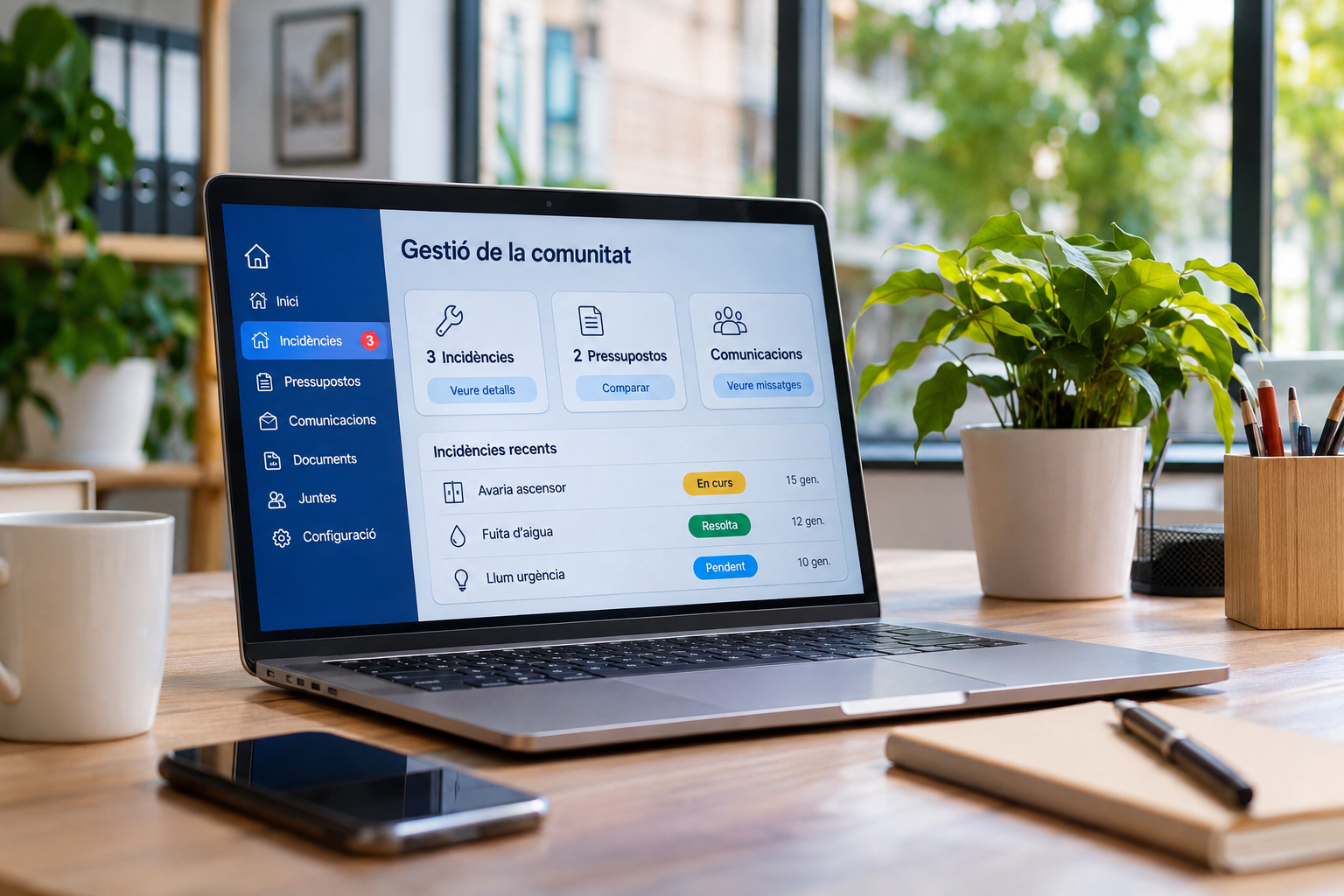
The digitization of property management has shifted from being a differential option to becoming a daily necessity. Communities, managers, and owners increasingly interact with apps, online portals, and platforms that centralize three key tasks: incident management, budget requests and comparisons, and communication between neighbors and professionals. The push is not only technological but also legislative. The Congress of Deputies admitted to processing in May 2026 a reform of the Horizontal Property Law that, among other novelties, recognizes email as a valid means of notification to owners and opens the door to digital minute books. This context further accelerates the transformation of a sector that, according to several recent studies, still has a way to go in homogeneous digitization.
What Really Changes with the Digitization of Property Management
For years, digitizing a community was limited to having accounting in a management program. Today the concept is much broader: it implies that incident reports, budget requests, and messages between the manager, board, neighbors, and professionals flow through traceable digital channels, rather than relying on calls, loose emails, or notes on the bulletin board. Web portals and apps for neighbors allow access to documentation, communication between owners, and incident notification quickly and efficiently. The result is a digital file per community: who reported what, when it was budgeted, which professional resolved it, and what documentation was archived.
This demand is not only from the manager but also from the owner. Various industry barometers indicate that a large majority of community owners in Spain prefer to communicate with their manager through an app or web platform rather than by phone or email. Ignoring this preference has a cost: communities perceive a less agile service, and managers spend more hours on repetitive tasks.
Online Incident Management: From Paper Report to Digital Ticket
One of the areas where the difference is most noticeable is in online incident management. Instead of the neighbor calling the doorman, the president, or directly the manager to report a leak or an elevator malfunction, the report becomes a digital ticket with date, description, photos, and, in many cases, geolocation within the building. This allows prioritization according to urgency, assignment to the appropriate professional, and tracking of the status without relying on anyone's memory. For the manager, it means fewer calls interrupting the day and an organized history that facilitates justifying decisions to the board. For the owner, it means knowing at all times whether their incident is pending, in progress, or resolved, without having to insist.
Budget Platforms: Compare Without Losing Weeks
The second pillar of digitization is budget management. Requesting three budgets by phone, waiting for responses by mail, and comparing different conditions in different formats remains, in many communities, a bottleneck that delays urgent decisions. A budget platform for professionals allows a request to be launched once and receive comparable proposals from verified providers, reducing the time between detecting a need and awarding the work. If your community needs renovations, maintenance, or a one-time repair, you can request a budget centrally and let the professionals respond with clear conditions, instead of chasing them one by one.
Communication with Neighbors and Professionals in One Channel
The third pillar, and probably the one that eliminates the most friction, is unifying communication. When the notice of an incident, the associated budget, and the messages with the professional resolving it live on different platforms, the information fragments and it's easy to lose track. Integrating these flows in the same environment allows the manager, the board, and the affected neighbor to see the same status of the incident, without forwarding screenshots or duplicating explanations.
The legal framework is pushing in this same direction. The proposed reform of the LPH modifies articles 9.1.h, 15.1, and 19.1 to allow meetings by videoconference, digital minute books, and email notifications. This bipartisan support, with 306 out of 349 deputies in favor, reflects an unusual political consensus on modernizing community management. The most realistic estimate places the entry into force between late 2026 and mid-2027, so managers and communities should prepare their digital tools before the rule becomes mandatory.
What a Good Digital Management Platform Should Have
Not all digital solutions provide the same value. When evaluating a tool for your community or your property portfolio, consider:
- That it allows reporting and tracking incidents from a mobile device, without the need for calls.
- That it facilitates comparing budgets from different professionals under homogeneous conditions.
- That it centralizes documentation (minutes, contracts, policies) in a single access for the manager and owners.
- That it guarantees traceability: who requested what, when, and with what response.
- That it complies with the data protection requirements demanded for any management of owner information.
The trend also points to greater interoperability among these functions: integrations with banks, public bodies, service providers, and tax platforms are increasingly important within the sector's management systems.
Take the Step Towards a More Digital Community
The digitization of property management is no longer a promise for the future: it is a reality advancing with the support of owner demand and, increasingly, with the push of regulations. Centralizing incidents, budgets, and communication on platforms designed for this saves time, reduces friction between neighbors, managers, and professionals, and leaves an organized history that facilitates any future decision. If you want to start simplifying your community's management, explore ForConnect's directory of trusted professionals and discover how easy it can be to coordinate incidents, budgets, and communication from one place.