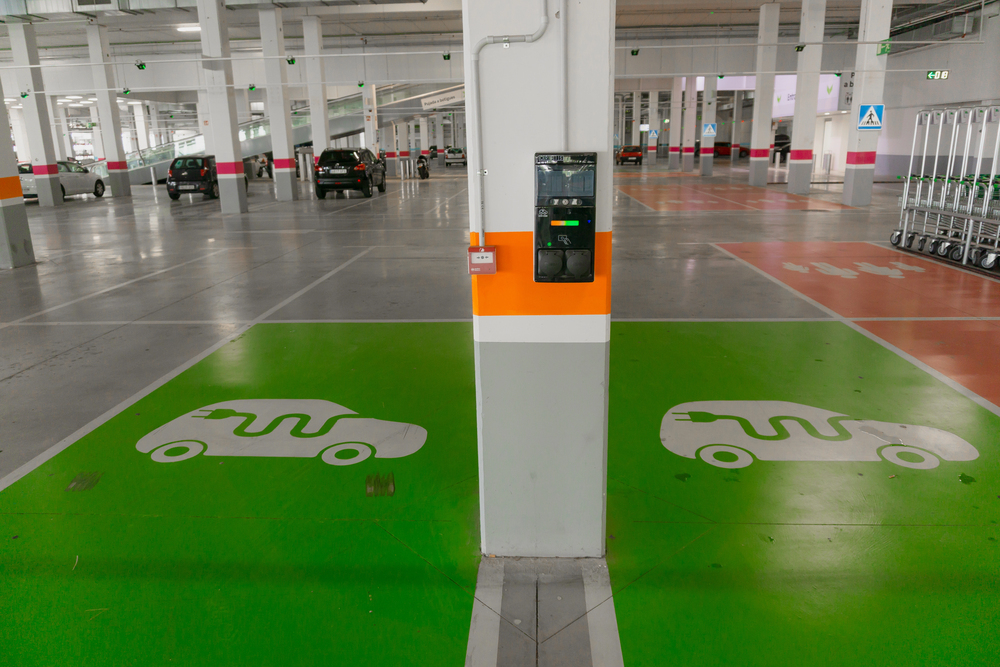
Sustainability has ceased to be a trend and has become a daily requirement in the management of homeowners' associations. Among the challenges that generate the most questions for administrators and community presidents is the installation of electric car charging points in community, but it is not the only one: early leak detection, efficient waste management, and water savings are part of the same goal: more efficient buildings, cheaper to maintain and prepared for the future.
Electric car charging points in community: what the regulations say
Electric mobility has gone from being an exception to a common reality in community garages, and legislation has adapted to facilitate its deployment. Article 17.5 of the Horizontal Property Law expressly recognizes that any owner with a parking space in a community can install an individual electric vehicle charging point in their own space.
This means that, for private use installations, no board approval is required for individual installations with derivation from the owner's meter, and the community cannot prohibit or hinder the installation if legal and technical requirements are met. The interested owner only needs to follow a simple procedure:
- They must notify the president or administrator in writing of their intention to install the charging point, and the community must acknowledge receipt of the communication, without being able to veto it, only to be informed about the project.
- The owner assumes 100% of the cost of the installation, equipment, and associated electricity consumption, without the community bearing any cost of the individual installation.
- The community must facilitate access to common areas for cable routing, allowing the necessary work on common elements to bring the cable to the space.
On the technical side, the installation must comply with specific regulations: ITC-BT-05 requires the Electrical Installation Certificate and the Technical Design Report for the legalization of all low-voltage installations, while ITC-BT-52 specifically regulates infrastructures for electric vehicle charging, particularly for collective installations or with power exceeding 50 kW.
What if the community wants to install common charging points?
The scenario changes when it is not an individual installation, but charging points for visitors or shared use. In that case, a board agreement is required and is approved with the simple majority of article 17.5 LPH, and the cost is shared among all owners, unless there is an express exemption in the statutes. For administrators, this point is key when planning the budget and explaining to the board the differences between both scenarios.
Given the pace at which demand is growing, many communities are beginning to consider a common pre-installation that facilitates future individual point connections without repeated works. Having a specialized professional through the ForConnect directory helps avoid technical errors and comply with regulations from the outset.
Water leak detection in the building: from repair to prevention
An undetected water leak can generate exorbitant bills and structural damage affecting several homes. The good news is that technology has advanced significantly in this area. An ultrasonic sensor measures the time it takes for a signal to travel through the water, measuring from 1 L/h, with precision that mechanical meters do not reach at the extremes of their range.
These smart meters not only measure consumption but also monitor usage patterns: the device stores a consumption history with hourly resolution and sends it to a management platform, and if it detects a pattern compatible with a water leak, reverse flow, or fraud, it generates an alert. This is especially useful in communities, because an undetected leak can generate billable consumption for months, and by recording consumption in short intervals, the meter identifies anomalous patterns —such as continuous activity at night— and triggers an alert, avoiding very high bills.
For existing leaks, there are also non-invasive solutions that avoid unnecessary works. Thanks to technological innovation, it is now possible to locate the exact point of a leak without breaking walls, floors, or pipes, drastically reducing intervention times and repair costs. This combination of continuous monitoring and precise location is changing the way administrators manage the hydraulic maintenance of buildings.
Waste management: the pending challenge in many communities
Waste separation at source and proper management of community collection points remain a pending issue in many properties. A well-designed waste space, with differentiated and accessible containers, facilitates regulatory compliance and reduces neighborhood conflicts over bad odors or garbage accumulation. Periodically reviewing this space, along with other common facilities, is part of an integral sustainable management of the building.
Water savings and efficiency: installations that make a difference
Beyond leak detection, water savings in common areas involve specific technical decisions: low-consumption faucets in community areas, cistern checks, and efficient irrigation systems in community gardens when available. In homes and homeowners' associations, meters individualize the consumption of each home and help detect leaks in the building's internal network, which also allows for a fairer distribution of costs among owners.
Integrating these measures into a building sustainability plan, along with electric mobility and waste management, turns the property into a more efficient space prepared for the regulatory demands that will likely continue to arrive in the coming years.
How to start: the role of the administrator and trusted professionals
None of these improvements work in isolation. The key is to have a technical team that understands both the legal part and the practical installation, whether for a charging point, a leak detection system, or an improvement in waste management. If your community is considering taking the step, you can request a quote from verified professionals at ForConnect and compare proposals adapted to the real needs of the building, without surprises or unnecessary delays.
Sustainability in the community of neighbors is not an expense, it is an investment that translates into fewer breakdowns, more controlled bills, and a building better prepared for the future. Taking the first steps with good technical advice makes the difference between acting in time or regretting the costs of not having done so.