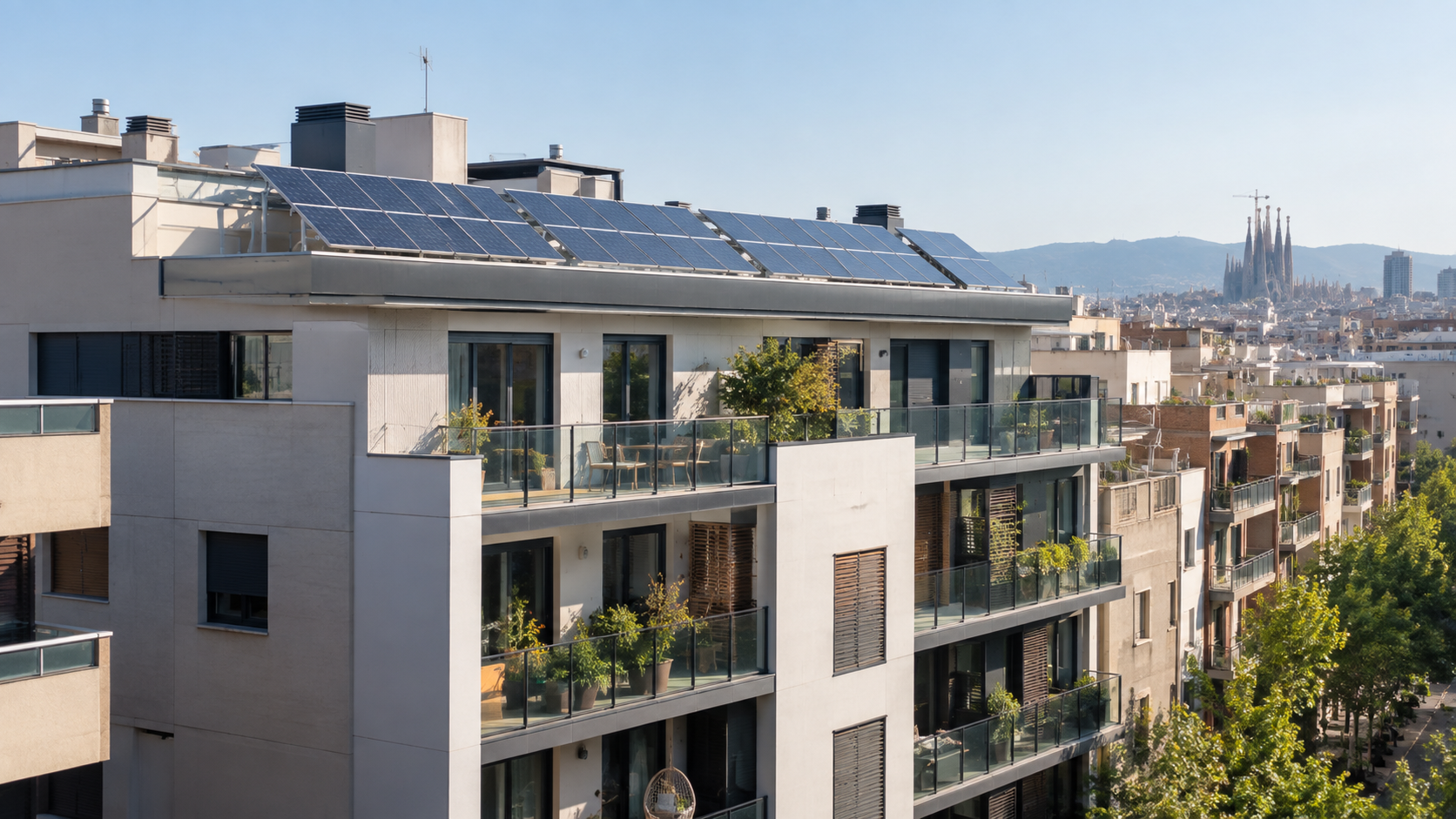
Energy efficiency in homeowner associations has shifted from a technical debate to an economic priority. With electricity and gas bills increasingly impacting community budgets, more and more homeowner associations are considering actions like insulation, efficient climate control, or self-generation of energy. The good news is that by 2026, the regulatory framework has moved in the right direction: it's easier to approve renewable installations, there are longer deadlines and higher aid percentages for renovations, and the energy certificate itself is being modernized. We review the key points for your community to make informed decisions.
Fewer obstacles to approve renewables in meetings
One of the historical obstacles for communities when installing solar panels, aerothermal, or geothermal systems was neighborhood consensus, as these works usually required high majorities and long negotiations. This has changed significantly: Royal Decree-law 7/2026, approved on March 20, 2026, reduces the majority needed in homeowner associations to install renewables to one-third, in line with what was already stipulated in article 17.1 of the Horizontal Property Law for renewable energy systems. Additionally, a favorable vote from 1/3 of the owners representing 1/3 of the participation quotas is required to approve self-consumption installations, and those who do not vote in favor are not obliged to financially participate in the project or benefit from it. This reduction in majorities greatly facilitates the process in communities where previously a single opposing neighbor could block the installation for years.
Collective self-consumption: more scope and less paperwork
Collective self-consumption with solar panels is, along with aerothermal energy, the star action of recent months. The regulations have notably expanded its possibilities: the same Royal Decree-law 7/2026 extends the maximum distance for collective self-consumption from 2 to 5 km, creates the figure of the self-consumption manager, and extends IRPF deductions and depreciation freedom for companies until December 31, 2026. In practice, this means that a community no longer depends on having its own available roof: it can share an installation located in a nearby premises, municipal building, or warehouse, as long as it is within that radius.
Additionally, the figure of the self-consumption manager centralizes the procedures and prevents each neighbor from having to negotiate separately with the distributor, which significantly simplifies management when several supplies share the same installation. In the fiscal field, conditions also improve: the 10% IRPF deduction for individual installations rises to 20% if it is in a homeowner association, with a base of up to €5,000 per year. Still, it is worth remembering a fact that remains a challenge: Spain is a country of apartments, with 70% of the population living in multifamily dwellings, but only 1% of self-consumption installations correspond to collective modalities. The growth margin is enormous, and communities that move now will be able to better take advantage of the current aids and deductions.
Aerothermal: the alternative to community gas boilers
In buildings with centralized heating and hot water, replacing the gas boiler with an aerothermal system is one of the decisions with the greatest impact on comfort and energy bills. For communities with centralized heating and hot water services, energy savings and supply are key, and many are replacing their gas boilers with aerothermal systems, an efficient and profitable alternative for heating, cooling, and DHW. There are two main approaches:
Centralized installation: based on one or more aerothermal units serving the entire building from a common technical room, from where energy is distributed to each dwelling, usually with individual consumption meters.
Individualized installation: simpler to execute in buildings without prior infrastructure, although it is faster to implement and allows total independence, so in buildings without prior infrastructure, individual solutions are often chosen, although in the long term they are not as efficient as a well-planned collective installation.
The profitability depends greatly on the building's starting point: amortization is usually slower than in the case of a photovoltaic installation, but medium and long-term savings are significant, especially if the building already has a centralized heating or cooling system. Before deciding, it is advisable to have an independent technical study that compares scenarios and calculates the real return for your community. In the ForConnect professional directory, you can find installers specialized in climate control and renewable energies who have already assisted other communities in this type of project.
Energy renovation: aid window open, but with a deadline
If your community plans to act on the facade, roof, or windows, this is a good time to do so, although deadlines are not indefinite. In Barcelona, for example, actions must demonstrate a minimum reduction of 35% in energy demand and 30% in non-renewable primary energy consumption, and applications in the city can be processed until June 30, 2026, through the Consorci de l'Habitatge. Throughout Catalonia, aids can cover between 30% and 80% of the cost, depending on the energy savings achieved and the active program at the time of application, and the amount is usually directly linked to the improvement in the energy rating achieved. Common requirements that should be resolved before applying:
Have the Building Technical Inspection (ITE) approved or in process, and demonstrate the reduction in non-renewable primary energy consumption through an energy certificate before and after the work.
Have a technical project drafted by a competent professional and with the corresponding community agreement.
Verify compatibility between different aid lines, as some municipal calls may be incompatible with each other at the individual housing level.
Finding the right architect, surveyor, or renovation company makes the difference between a well-prepared application and one denied due to lack of documentation. Requesting several quotes through the ForConnect request platform helps compare technical and economic proposals before bringing the decision to the meeting.
The energy certificate also modernizes
The building energy efficiency certificate remains the mandatory entry point to access subsidies and justify improvements to the administration, but its management is changing this year. On one hand, control over who can issue it is strengthened: from July 23, 2026, the accreditation of technicians is based on a system that combines degrees, training, and professional qualifications, in addition to a responsible declaration, and professionals are incorporated into a registration and control system. On the other hand, the technical documentation changes: until September 29, 2026, the current models will continue to apply, and from the 30th, technicians and entities that prepare, review, or register certificates must work with the new documentation. For communities already with a valid certificate, the reassurance is that there is no obligation to renew it all at once: the answer is no, certificates that are already in force will remain valid until their expiration period, unless major reforms are carried out that advise issuing a new one. However, it is worth remembering that an energy efficiency certificate generally has a maximum validity of ten years, and when the obtained rating is G, its maximum validity is five years, so checking the expiration date should be part of the usual documentary maintenance of any property.
How to start without blocking the meeting
The experience of many communities shows that the biggest barrier is not technical or economic, but neighborhood consensus. To move forward without prolonging the process:
Commission a preliminary energy study that compares insulation, aerothermal, and collective self-consumption according to the real needs of the building.
Present scenarios in the meeting with estimated savings figures and amortization periods, not just the initial cost.
Take advantage of the fact that the majority required for renewables has been reduced to one-third of owners and quotas, which speeds up the voting process.
Request several quotes from accredited professionals before deciding, to compare equivalent technical solutions.
Energy efficiency is no longer just an environmental issue: it is direct savings on the monthly fee and an increase in the building's value in the medium term. If your community wants to take the step with guarantees, in the ForConnect directory you will find professionals specialized in insulation, climate control, and solar energy, and through our budget request form you can compare real proposals without relying on word of mouth.