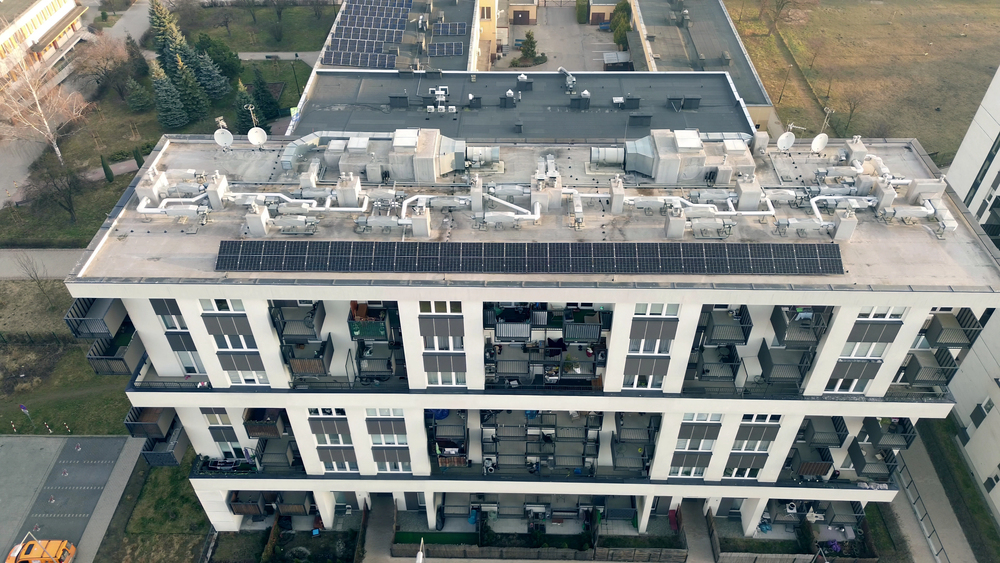
Energy efficiency in homeowner communities has shifted from being an environmental gesture to becoming a roadmap with dates, regulations, and, above all, real savings on bills. The starting point is no longer choosing a specific technology, but understanding how the energy certificate, envelope insulation, centralized aerothermal, collective solar panel self-consumption, and available energy renovation programs fit together in each territory, with Barcelona and Catalonia as one of the country's most active scenarios.
The Energy Efficiency Certificate: The Diagnosis That Guides Other Decisions
Any community looking to improve its efficiency should start with the building's energy efficiency certificate, as it is no longer just a formality for selling or renting an apartment. The certificate is no longer just a paper for selling or renting an apartment, but the key to renovation aids and tax deductions for energy efficiency. This is coupled with a fundamental change driven from Europe: before May 29, 2026, building energy certification systems must adapt to a new community scale using letters from "A" to "G", where "A" corresponds to zero-emission buildings, and "G" to the least efficient in the national stock. The practical consequence is significant for many old residential blocks: buildings with energy ratings F and G must undergo mandatory renovation before 2030. Additionally, it is worth remembering that for properties that receive a G energy rating, the maximum validity is reduced to 5 years, compared to the usual ten years, which requires an earlier review of the building's condition. Requesting this diagnosis from a competent technician is the first step before convening any meeting to discuss improvement works.
Envelope Insulation: The Foundation Before Any Installation
Before considering new equipment, the building's envelope—facades, roofs, windows, and thermal bridges—determines how much energy is lost or retained. A poorly insulated facade can nullify much of the savings sought later with a more efficient climate control system or solar panels. Therefore, in many energy renovation projects, the logical order is: first reduce demand (insulation, efficient carpentry, sealing thermal bridges) and then size generation or climate control based on that already reduced demand. This sequence avoids oversizing installations and improves the return on investment for the entire community.
Centralized Aerothermal: When Climate Control Change is Collective
In buildings with centralized heating or hot water, replacing an obsolete collective boiler with a community aerothermal system is often one of the decisions with the greatest impact on the building's overall energy bill. Unlike an individual installation, here community-specific variables come into play: available space for outdoor units, cost distribution among owners, compatibility with the existing internal distribution network, and the need for a prior technical study to confirm expected savings. Before putting the proposal to a vote, it's advisable to have comparable budgets and a specific analysis for the building, something that a directory of professionals specialized in climate control and energy efficiency can facilitate in an orderly manner.
Collective Solar Panel Self-Consumption: What's Changing in 2026
Collective self-consumption allows several homes in the same building to share energy generated by a single photovoltaic installation, something especially useful in communities without individualizable roofs. The regulations have made a significant leap this year: RD-law 7/2026 dedicates a specific block to self-consumption and energy communities, and the maximum distance for collective self-consumption through the network increases from 2 to 5 km for installations up to 5 MW, opening the door to projects that were previously unfeasible. To approve this type of installation in a meeting, only one-third of the owners representing at least one-third of the participation quotas is required, a more accessible majority than before. Economically, owners of homes in residential buildings where self-consumption is installed can deduct 20 percent of what they pay for the installation, with a maximum base of 5,000 euros per year, and according to some estimates each home could save between 180 and 260 € per year on their bill, depending on consumption. These are indicative figures that should always be contrasted with a specific technical study before deciding.
Energy Renovation in Barcelona and Catalonia: An Active Moment
Catalonia is visibly driving the debate on improving the energy efficiency of the existing building stock. The Institut Català d'Energia (ICAEN) has organized a course on positive energy buildings aimed at professionals in design, construction, renovation, and energy management, whose first session addressed the adaptation of European energy efficiency regulations and residential renovation strategies in Catalonia. In parallel, there are active financing channels for homeowner communities wanting to undertake an energy renovation of buildings in Barcelona, mainly channeled through the Consorci de l'Habitatge and European funds, although many of these calls have tight execution deadlines throughout 2026, so it is advisable to be informed of the current conditions before planning the work. The usual procedure involves starting from the initial energy certificate, commissioning a technical project that quantifies the expected savings, and submitting the application before the close of each call.
How to Move Forward Without Losing Priority Order
- Request the updated energy efficiency certificate to know the building's real starting point.
- Prioritize insulating facades, roofs, and carpentry before investing in new equipment.
- Evaluate if centralized aerothermal is technically and economically viable for the building.
- Study collective solar panel self-consumption considering the new majorities and allowed distances.
- Review current aids in each autonomous community before finalizing the budget.
Each homeowner community has different needs, and correctly combining insulation, aerothermal, collective self-consumption, and energy renovation requires professionals working in a coordinated manner. At ForConnect, you can consult our trusted professional directory specialized in energy efficiency, or request a quote so your community receives proposals tailored to its building and the available aids in your area.