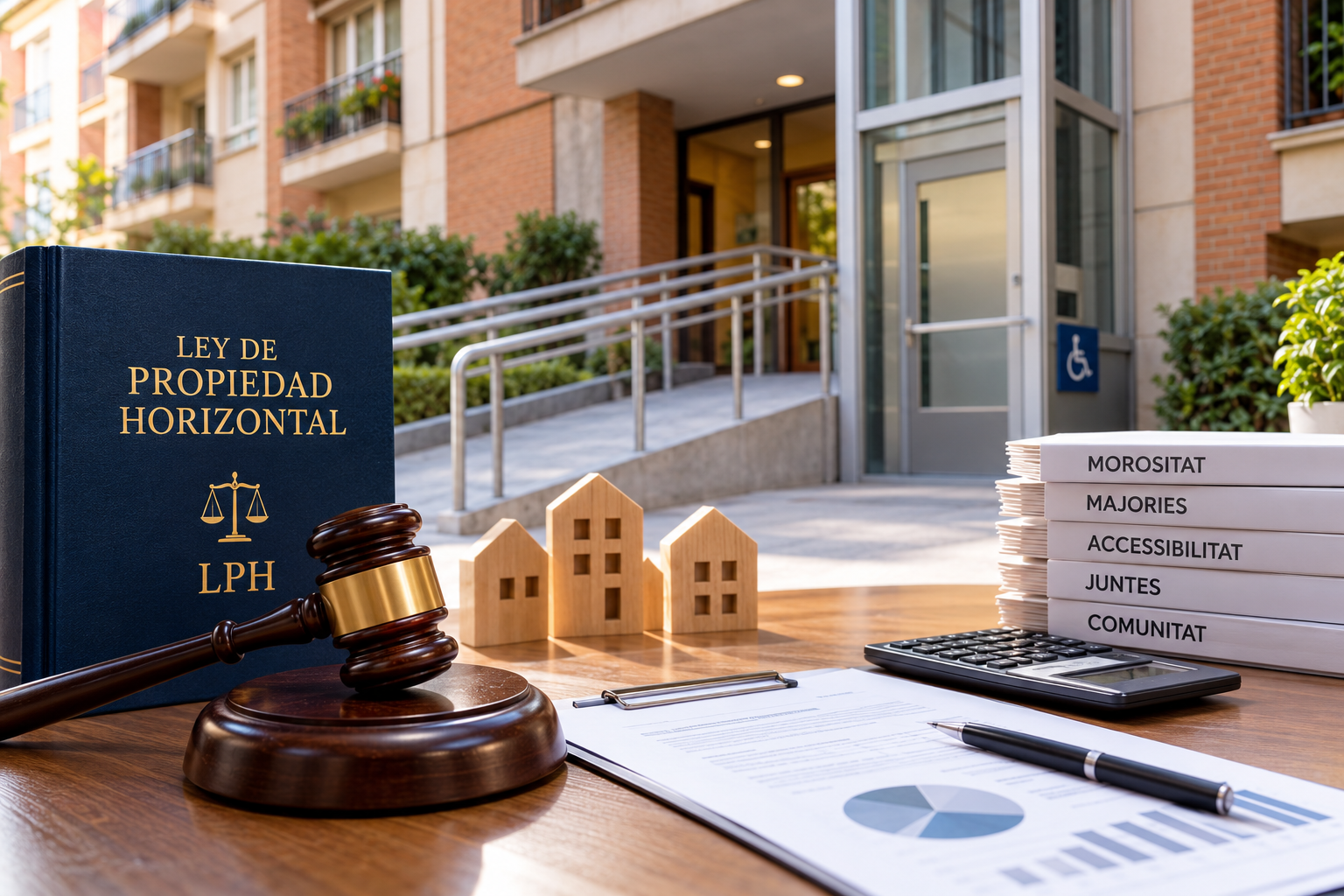
The Horizontal Property Law (HPL) continues to be the framework governing the daily life of thousands of homeowners' associations in Spain. However, its modifications and court interpretations make it necessary to stay updated to correctly manage issues such as delinquency, the majorities required to adopt agreements, or accessibility works.
If you are a property manager, community president, or owner, knowing these issues will help you make decisions with more legal certainty and prevent conflicts among neighbors.
Delinquency in the Homeowners' Association: What Measures Can Be Taken?
Fighting non-payments is one of the most important aspects of the economic management of a homeowners' association.
The HPL allows communities to adopt deterrent measures against delinquency, such as establishing interest rates higher than the legal interest or temporarily depriving the use of certain common services or facilities.
These measures, however, must be proportionate, cannot be abusive, and in no case can they affect essential elements for the habitability of the property. For example, under certain circumstances, access to common recreational facilities could be limited, but not to essential housing services.
When the debt persists, the community can also resort to the monitoring procedure to judicially claim the outstanding amounts. This procedure is specifically designed to facilitate the claim of accredited monetary debts and is not limited exclusively to debts under 2,000 euros.
Another important aspect is the participation of the delinquent owner in the meeting. The owner who is not up to date with the payment of overdue debts with the community can attend and intervene in the deliberations but is deprived of the right to vote, except in legally provided cases.
In buying and selling operations, the certificate on the status of debts with the community is also particularly important. The regulations establish that this certificate must be issued within a maximum period of seven calendar days from its request.
Therefore, good property management must have a clear protocol for monitoring non-payments and act before debts accumulate for months.
Agreements in Meetings: What Majority Does Each Decision Require?
Correctly determining the necessary majority is one of the issues that generate the most doubts in homeowners' meetings.
The HPL establishes different majorities depending on the type of agreement. In some cases, unanimity is required, especially when it is intended to approve or modify certain rules contained in the constitutive title or the community statutes.
In other cases, the regulations establish reinforced majorities, such as three-fifths of the total owners and participation quotas, for certain actions or improvements to the building.
For ordinary management agreements that are not subject to a specific majority, the majorities generally provided by the HPL apply.
However, it is important to differentiate these agreements from the mandatory works provided for in article 10 of the HPL. Certain necessary actions for the conservation, safety, habitability, or accessibility of the building may be mandatory and do not require a prior meeting agreement to determine if they should be carried out.
Furthermore, when calculating a majority, the number of owners is not the only important factor. The HPL usually combines the number of owners with their participation quotas, so it is essential to check both elements before considering an agreement approved.
Accessibility Works: When Are They Mandatory?
Accessibility is one of the areas where the HPL establishes particularly important obligations for communities.
Article 10.1.b of the HPL provides for certain mandatory actions in terms of accessibility when requested by owners in whose home or premises people with disabilities or over 70 years old live, work, or provide voluntary services.
These actions may include the installation of elevators, ramps, or other mechanical and electronic devices that facilitate orientation or communication with the outside.
In these cases, it is especially important to consider the economic criterion established by the regulations. Among the legally provided cases are actions when the annual amount charged, once public subsidies or aids are deducted, does not exceed twelve ordinary monthly installments of common expenses.
The regulations also contemplate other situations where these actions may be mandatory, for example, depending on the available public aids.
Moreover, if the meeting validly adopts an agreement to execute accessibility works, the community is obliged to pay the corresponding expenses even if the amount may exceed these twelve monthly installments.
For this reason, before making a decision, it is advisable to study the specific case, check the possible available subsidies, and request several quotes from specialized companies.
Digitalization of Communities: A Trend That Continues to Advance
Digitalization is also transforming the way homeowners' associations are managed.
Management platforms, electronic notifications, portals for owners, and digital systems to manage incidents and budgets allow reducing administrative tasks and improving communication.
However, it is necessary to differentiate this digitalization from the possibility of holding entirely telematic meetings.
As of October 2026, the state HPL does not yet generally establish the holding of homeowners' meetings exclusively by videoconference as an ordinary alternative equivalent to face-to-face meetings.
Precisely, the regulation of telematic meetings, electronic notifications, and other digital tools has been the subject of recent legislative initiatives, so it is an area where administrators and communities will need to be especially attentive to future regulatory changes.
What Should Administrators and Community Presidents Do?
Given this regulatory framework, it is advisable to periodically review the community statutes, properly document the agreements adopted in meetings, and check in each case what majority the HPL requires.
It is also important to act quickly in the face of the first non-payments, preventing delinquency from becoming a structural problem for the community's treasury.
In the case of conservation or accessibility works, having several professional quotes allows knowing the real cost of the action, evaluating technical alternatives, and studying possible aids before executing the works.
If you need to compare quotes from installers, rehabilitation companies, elevators, or other professionals specialized in homeowners' associations, you can consult the ForConnect professional directory, where you will find companies specialized in different services for communities.
And if your community already knows what action it needs, you can also request quotes through ForConnect and compare different proposals before making a decision.
Staying updated on the Horizontal Property Law is not just a matter of regulatory compliance. Good management prevents conflicts, protects the community's economy, and ensures safer, more accessible, and well-maintained buildings.
At ForConnect, we will continue to inform about the updates affecting property managers, presidents, and homeowners' associations.