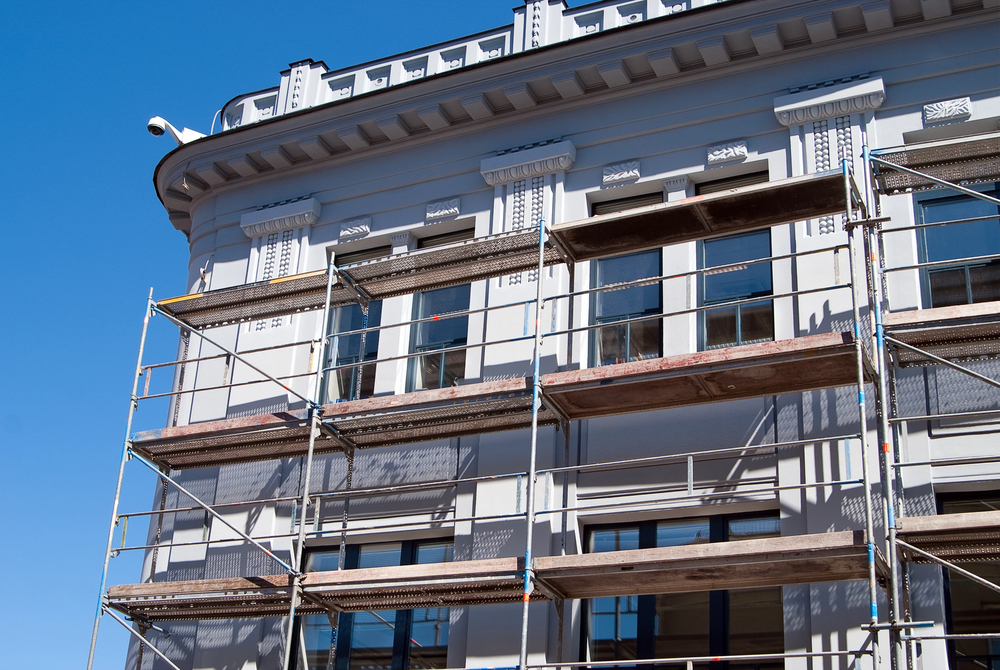
A facade that needs rehabilitation, homes that quickly lose temperature in winter, excessive heat in summer, or installations with high energy consumption. When these problems coincide in the same building, proposing an energy rehabilitation of the community of owners can allow going beyond repairing damages and improving the building's performance over the coming decades.
The main barrier usually appears when the budget arrives. A comprehensive rehabilitation represents a significant investment, and not all families have the same economic capacity. Therefore, before discarding a project due to its initial cost, it is advisable to study what needs to be rehabilitated, what savings can be achieved, and what ways exist to reduce or finance the investment.
What does an energy rehabilitation of a building include?
Energetically rehabilitating does not simply mean repairing a deteriorated facade. The goal is to act on the building elements that condition its consumption and achieve that it needs less energy to maintain adequate comfort conditions.
One of the most common interventions is the improvement of the thermal envelope, that is, the elements that separate the interior from the exterior: facades, roofs, enclosures, and other points through which the building can lose or gain heat.
Actions can also be considered on thermal installations, air conditioning systems, or the incorporation of renewable energies.
The IDAE precisely identifies the improvement of the envelope and thermal installations among the main types of energy rehabilitation actions. The goal is to reduce final energy consumption and emissions associated with buildings.
Therefore, two communities with seemingly similar buildings may require very different interventions.
How much does it cost to energetically rehabilitate a community?
There is no single price that allows answering this question rigorously.
The budget depends on factors such as the building's surface area, conservation status, construction system, action on facades and roofs, existing installations, work accessibility, and the level of energy improvement desired.
Therefore, valuing a rehabilitation solely based on a price per square meter can lead to incorrect conclusions.
The community should start with a technical diagnosis that allows identifying where the main inefficiencies occur and which actions offer a better relationship between investment, savings, and building improvement.
This analysis is especially important when the community already has to face a major work. If it is necessary to intervene on a deteriorated facade, for example, it may be a good time to study whether it is technically and economically convenient to incorporate an insulation improvement.
The work budget is not always the final cost for the owners
This is one of the most important concepts before bringing a rehabilitation to the board.
The budget figure explains how much it costs to execute the project, but not necessarily how much each owner will end up assuming.
Depending on the characteristics of the action and the calls in force at any given time, there may be mechanisms that reduce the economic effort: public subsidies, instruments linked to energy savings, or financing solutions.
Therefore, a community should not decide if a rehabilitation is viable solely by looking at the first budget figure. It is necessary to calculate the estimated net cost after analyzing all available avenues.
Rehabilitation aids: it is necessary to check which ones are really in force
Public programs in recent years have promoted actions aimed at reducing the energy consumption of buildings. The IDAE maintains specific information on the different energy rehabilitation programs and the actions that may be eligible for aid.
But there is a mistake that a community must avoid: assuming that a subsidy seen months ago on the internet is still available under the same conditions.
Calls may have different deadlines, budgets, technical requirements, and beneficiaries. Some previous programs are already listed as closed calls, while other lines have a specific territorial or sectoral application.
Therefore, before approving a work conditioned to a certain aid, the administrator and the community should verify the applicable call, deadlines, and requirements in official sources.
What are Energy Savings Certificates (ESC)?
The Energy Savings Certificates, known as ESC, introduce another interesting variable in the financing of energy efficiency actions.
An ESC certifies a final energy saving achieved after executing an energy efficiency action. The system is regulated in Spain by Royal Decree 36/2023 and remains operational within the National System of Energy Efficiency Obligations. By 2026, the Ministry for the Ecological Transition expressly maintains the possibility that obligated subjects fulfill part of their obligations through the settlement of ESC.
Simply put: certain improvements that achieve a verifiable energy saving can generate additional economic value.
This makes it interesting to study the ESC from the beginning when projecting a rehabilitation and not when the work is already fully defined.
Do ESC replace subsidies?
No. They are different mechanisms.
A subsidy is a public aid subject to certain bases, requirements, and a specific call. The ESC, on the other hand, is related to the energy savings generated by an action and the state system created to certify these savings.
The specific compatibility with other aids or mechanisms must be analyzed in each project.
For a community, the important thing is to understand that the financing of a rehabilitation should not be studied from a single avenue.
The vision of EFFIC: proposing rehabilitation in a comprehensive way
This is where the experience of specialized companies can be especially useful.
EFFIC works as a rehabilitation manager for properties, especially in projects linked to energy efficiency, and incorporates into its proposal the comprehensive management of the process and the possibilities associated with energy savings.
The company declares more than 50,000 projects completed, presence in more than 3,000 municipalities, and more than 20 years of experience.
It also works specifically with the ESC system as a mechanism to transform the energy savings generated by certain actions into an economic return.
This approach allows asking a different question before a work: instead of only asking “how much will it cost us to rehabilitate the building?”, also ask “what will be the final cost for the community after analyzing all available options?”.
What should a community compare before approving the project?
Comparing three budgets by looking only at the final figure is insufficient in an energy rehabilitation.
The community should check that the different proposals contemplate an equivalent scope: materials, area of action, construction solution, waste management, auxiliary means, technical fees, deadlines, guarantees, and complementary actions.
It is also important that the planned energy improvements and how they will be justified are clear.
An initially cheaper offer may cease to be so if it excludes items that will appear later. And a proposal with a higher investment may be more interesting if it achieves a more significant energy improvement or facilitates access to cost reduction mechanisms.
When is it advisable to propose an energy rehabilitation?
It is not necessary to wait for the building to have a serious problem.
There are three particularly interesting moments: when the community already needs to intervene on the facade or roof; when there are recurring comfort or consumption problems; and when a major renovation of the installations is planned.
In these cases, comparing the cost of a conventional repair with that of an intervention that incorporates energy criteria allows making a more informed decision.
Energy rehabilitation should not be understood only as an expense aimed at fulfilling a work, but as a decision about how the building will function in the coming years.
EFFIC and ForConnect
EFFIC is part of the network of professionals linked to ForConnect and specializes in building rehabilitation and energy efficiency.
For property managers, having companies specialized in this type of project facilitates a particularly complex issue: coordinating the technical part of the rehabilitation with the economic analysis, possible aids, financing, and mechanisms such as Energy Savings Certificates.
If your community is considering a facade rehabilitation or an energy improvement of the building, at ForConnect you can find verified professionals and request advice or a budget before making a decision.