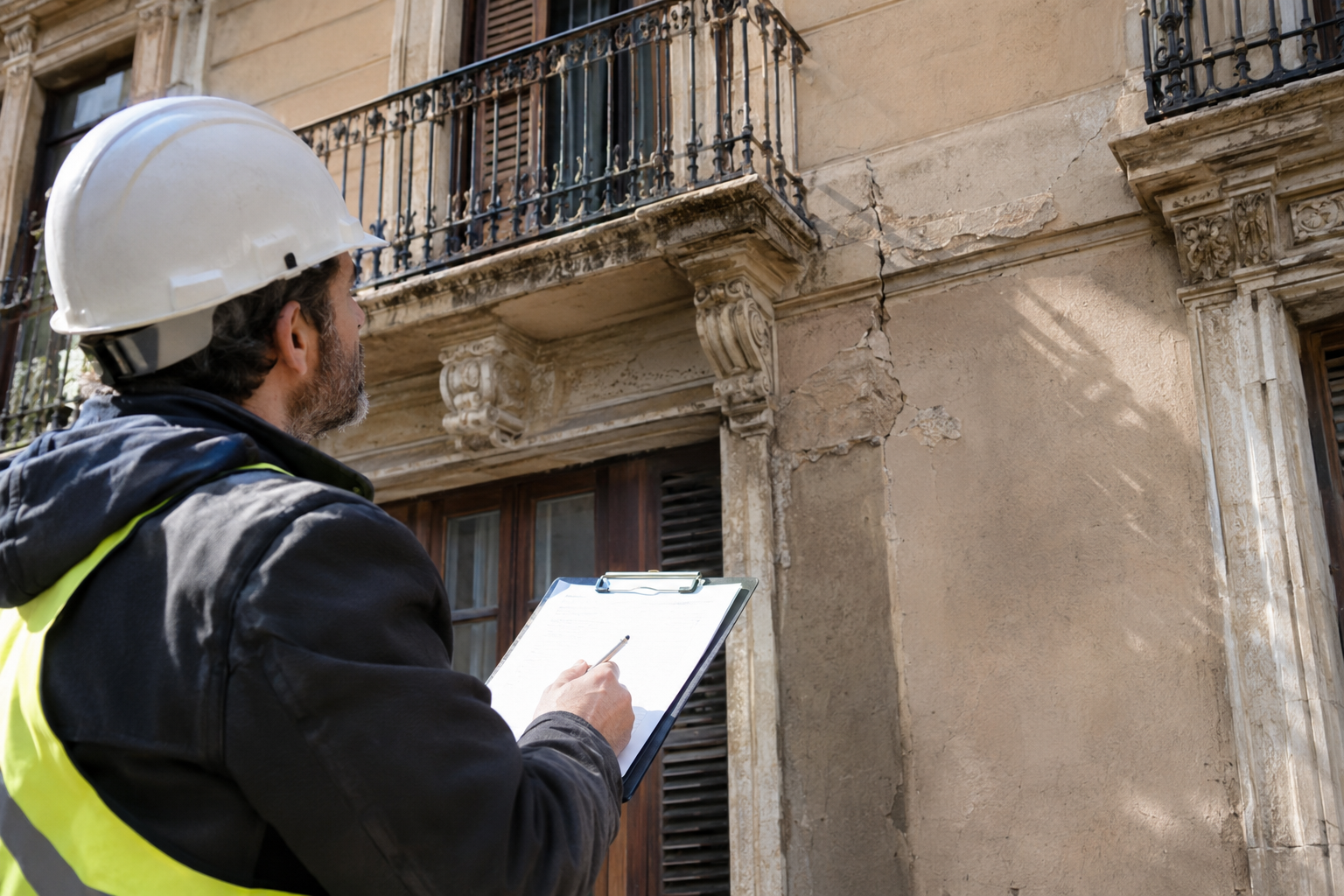
The Technical Building Inspection (ITE) in Catalonia is a mandatory procedure for many residential buildings that allows the assessment of their conservation status and the detection of potential structural, safety, or health issues. For homeowner associations and property managers, knowing the IITE deadlines, legal obligations, and necessary actions when deficiencies are detected is essential to avoid risks and possible penalties.
In Catalonia, this inspection is mainly regulated by Decree 67/2015, of May 5, which establishes when it must be carried out, how deficiencies are classified, and what responsibilities the property assumes.
When is the IITE mandatory in Catalonia?
Generally, multi-family residential buildings must undergo their first technical inspection before reaching 45 years of age.
There are also other situations where it may be necessary, such as when seeking certain rehabilitation grants or when required by the competent administration.
The inspection must be carried out by a competent technician, usually an architect or technical architect, who visually examines the building's elements to identify possible deficiencies.
Among the elements reviewed are facades, roofs, structural elements, common areas, and community installations that are part of the evaluation.
The goal is to detect conservation problems before they become risk situations for residents or third parties.
What are the IITE deadlines?
One of the most frequently asked questions is the frequency of inspections.
Catalan regulations establish that the validity of the fitness certificate depends on the building's conservation status and the severity of the detected deficiencies.
No deficiencies or minor deficiencies: fitness certificate valid for 10 years.
With significant deficiencies: provisional fitness certificate valid for 6 years, subject to technical verifications every 2 years.
With serious or very serious deficiencies and precautionary measures executed: precautionary fitness certificate valid for 3 years, subject to at least annual verifications or more frequent if determined by the technician.
Before the certificate's validity expires, the building must undergo a new inspection.
Additionally, once the IITE report is drafted, the property has four months from the issuance date to submit it to the Administration and request the fitness certificate.
Therefore, it is not enough to contract the inspection: the administrative process must be completed correctly.
What happens if the IITE detects deficiencies?
The technical report classifies deficiencies into four categories according to their severity.
Minor deficiencies
These are conservation issues that do not pose an imminent risk but require preventive or corrective maintenance work.
They may include certain superficial deteriorations, damage to coatings, or other maintenance incidents.
Although they do not usually require urgent interventions, it is important to correct them to prevent worsening over time.
Significant deficiencies
These are those that, without posing an imminent risk to the building's stability or people's safety, affect its functionality or healthiness and require corrective actions.
In these cases, the community must plan the necessary works and carry out the corresponding technical verifications.
Serious deficiencies
These are issues that may pose an imminent risk to certain building elements or the safety of people and property.
They may require immediate precautionary measures, such as protecting passage areas, restricting access to certain spaces, or securing deteriorated elements.
The community must act quickly and follow the instructions of the responsible technician and the competent administration.
Very serious deficiencies
These represent an imminent and widespread risk to the building's stability or people's safety.
These situations require immediate intervention and may involve exceptional measures, such as evacuating the building or other urgent safety actions.
What should the administrator do if the IITE detects deficiencies?
When the report identifies significant, serious, or very serious problems, the property manager plays a crucial role in coordinating the necessary actions.
The first step is to analyze the report with the responsible technician to understand the scope of the deficiencies, the necessary safety measures, and the applicable deadlines.
If there is an imminent risk, it is necessary to immediately prioritize the indicated precautionary measures. In these cases, the technician must also communicate the situation to the property and the City Council.
Subsequently, the administrator must coordinate the community to drive the necessary decisions, request quotes, and organize interventions.
The regulations establish that when deficiencies are detected, the property must approve a rehabilitation program within a maximum period of one year from receiving the report. If the deficiencies are serious or very serious, this period is reduced to six months.
It is important to note that these deadlines correspond to the approval of the rehabilitation program and do not mean that all works can be postponed until then. Urgent safety measures must be executed immediately when necessary.
To expedite the search for companies specializing in rehabilitation, facades, or building maintenance, the ForConnect professional directory facilitates locating professionals for this type of action.
What happens if the community does not comply with the IITE?
Failing to carry out the technical inspection when mandatory can lead to administrative, economic, and legal consequences.
The Housing Law 18/2007 considers it a serious offense not to have the technical inspection report when it is required.
In addition to possible penalties, failure to comply with the conservation duty may lead to administrative requirements to execute the necessary actions.
Lack of documentation can also create difficulties in certain real estate transactions.
In the transfer of a property located in a building required to undergo the ITE, the regulations provide for the delivery of the technical report and the fitness certificate, with the legally established particularities and exceptions.
This does not mean that the lack of a certificate automatically prevents selling a property, but it can complicate the operation and require documentary justification of the building's situation.
For this reason, keeping the technical documentation updated is an important responsibility for any community.
The importance of planning works after the IITE
An inspection with deficiencies should not be considered merely an administrative problem, but an opportunity to properly plan the building's maintenance and rehabilitation.
Acting preventively can prevent small incidents from evolving into more serious and costly problems.
For property managers, having specialized professionals facilitates comparing quotes, coordinating works, and monitoring established deadlines.
Through the ForConnect quote request service, communities and administrators can contact professionals to assess necessary actions on facades, roofs, structures, and other building elements.
IITE in Catalonia: Anticipating is the best way to avoid problems
The Technical Building Inspection is an essential tool to ensure the conservation and safety of the Catalan residential stock.
Knowing the deadlines, correctly interpreting deficiencies, and coordinating necessary actions allows communities to meet their obligations and avoid future complications.
If your building is approaching 45 years or already has an IITE report with deficiencies, it is important to act with foresight and have specialized technical advice.
At ForConnect, we help connect homeowner associations and property managers with professionals who can intervene in building maintenance and rehabilitation.