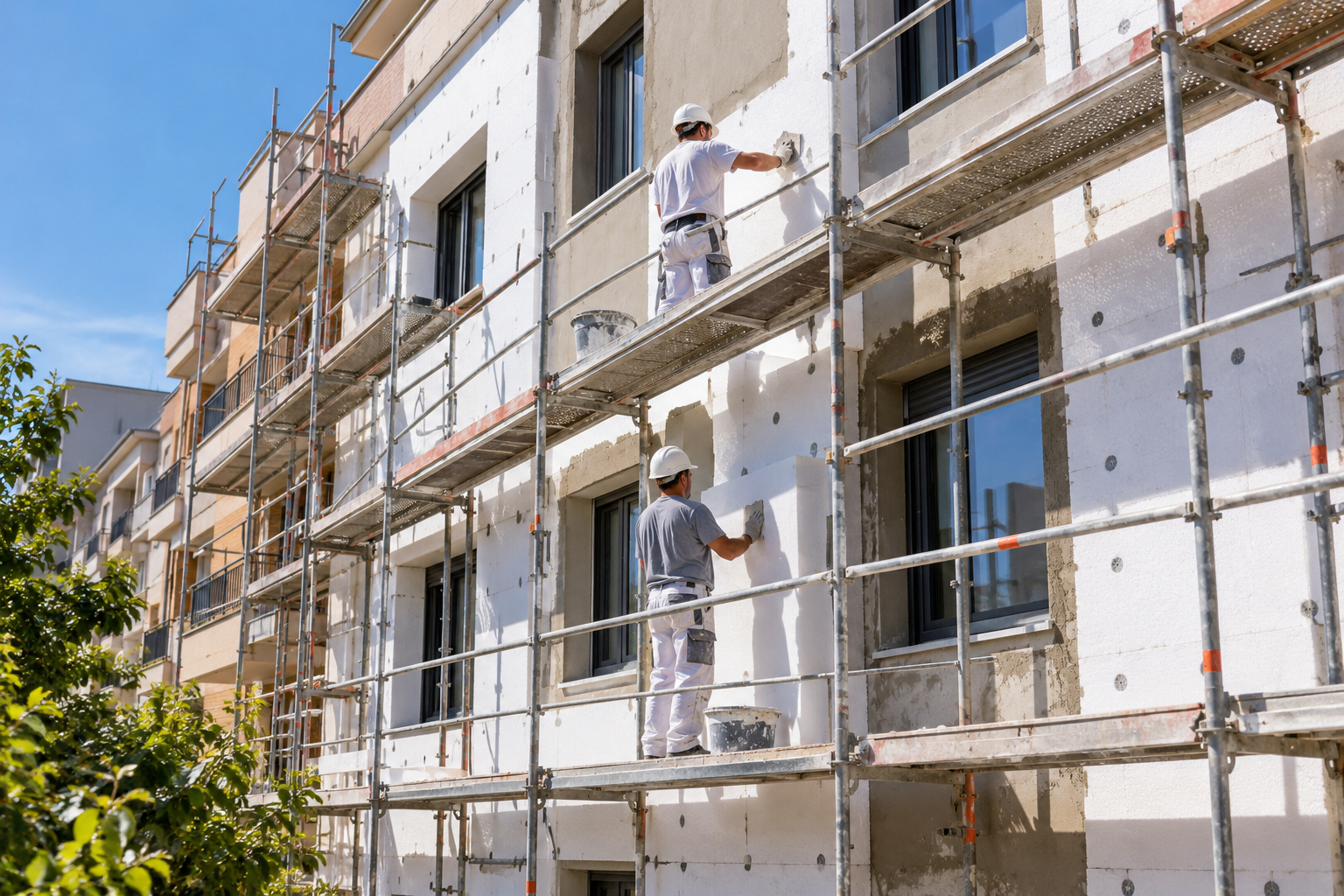
Cracks, detachments, leaks, deteriorated coatings, or problems with balconies may force a community of owners to intervene on the facade. At this point, an important decision arises: repair only the damage or take advantage of the work to also improve the building's thermal insulation?
These are not equivalent actions. A conventional renovation can restore the safety, watertightness, and conservation status of the facade, while an energy renovation incorporates solutions aimed at improving the thermal performance of the envelope.
Therefore, before approving a major work, it's advisable to study the building as a whole and think not only about current problems but also about the needs of the coming decades.
Repair the facade or renovate it energetically?
The first issue is understanding the difference.
A facade repair may include actions such as repairing deteriorated coatings, fixing cracks, intervening on balconies and cornices, solving leaks, replacing degraded elements, or applying new finishes.
Energy renovation goes further and intervenes on the envelope with the aim of reducing the building's energy demand.
The Technical Building Code establishes requirements related to the energy performance of the envelope, including aspects such as insulation, air permeability, treatment of thermal bridges, and the risk of condensation. Idae
This makes a major renovation an opportunity to consider if the building needs more than just repairing its exterior appearance.
Why might it be a good time to incorporate insulation?
For a practical reason: a significant part of the complexity of a renovation is already associated with intervening on the facade.
Scaffolding, auxiliary means, protections, labor, preparation of surfaces, and other works are part of the action. Therefore, if the building has poor thermal performance, it makes sense for the project to simultaneously study the possibility of incorporating insulation.
The IDAE precisely points out that a renovation work initially motivated by the building's deterioration can be an opportunity to introduce energy criteria. Idae
This does not mean that installing insulation is always the right solution. It means that it's worth studying it before deciding the final scope of the work.
Which buildings should especially consider this option?
The decision should start with a technical diagnosis, but there are situations that justify studying it with special attention.
For example, old buildings with little insulation, homes with very cold interior walls in winter or hot in summer, condensation problems related to thermal bridges, or communities that already need to carry out a comprehensive intervention on the facade.
It's also important to consider the roof. The IDAE identifies facades, roofs, floors, and openings as elements that can be acted upon to increase the heat resistance of the envelope. Idae
Therefore, a good renovation should not start by simply asking “what finish do we put on the facade?”, but by first identifying the pathologies and the overall performance of the building.
What is ETICS?
The External Thermal Insulation Composite System (ETICS) is a solution that incorporates a continuous layer of insulation on the exterior face of the facade and subsequently protects it through the different layers that make up the system.
The IDAE defines ETICS as composite external insulation systems used for the thermal insulation of buildings. Idae
One of its most interesting features in renovation is that it allows acting on the building from the outside and providing continuity to the insulation.
Façades Álamo works with this type of solution in renovation and highlights the importance of correctly resolving singular points such as balconies, roofs, windows, shutter boxes, and other construction joints. Fachadas Alamo
And this detail is fundamental: a good insulation system depends as much on the material as on the correct resolution of the facade's singular points.
ETICS or ventilated facade?
There is no universal answer.
In a ventilated facade, the insulation is placed on the exterior of the wall, and an air chamber is created between this insulation and the exterior cladding.
The IDAE explains that this solution incorporates a ventilated chamber behind an exterior leaf separated from the original facade by a structure, with the insulation fixed to the exterior face of the closure. Idae
Façades Álamo includes both ETICS and ventilated facades among its insulation solutions. Fachadas Alamo
Choosing between one alternative or another will depend on the existing facade, the detected pathologies, the building's architecture, the technical requirements, the desired finishes, and the available budget.
Therefore, the solution must be technically defined for each property and not simply copy the one used in another building.
Thermal bridges: one of the points not to be forgotten
Insulating a large facade surface and poorly resolving singular points can limit the intervention's result.
Thermal bridges are areas of the envelope where alterations in the continuity of the insulation occur, which can increase heat losses or gains.
Therefore, special attention must be paid to window contours, slabs, pillars, balconies, shutter boxes, cornices, and other joints.
The same CTE relates the proper treatment of thermal bridges with limiting heat losses and gains and with preventing hygrothermal problems. Idae
The vision of Façades Álamo
The experience that Façades Álamo presents on its website precisely reflects this need to address the facade as a whole.
The company works in facade renovation, roof waterproofing, ETICS, ventilated facades, vertical work, restoration of old elements, structural reinforcements, and other interventions related to the envelope. Fachadas Alamo
In a renovation, this global vision is especially relevant because a dampness, a crack, or a condensation can have different causes. Before choosing the treatment, it's necessary to identify its origin.
What should the community ask for before approving the work?
The first step should be to have a technical diagnosis of the facade's condition.
From there, the community can compare scenarios: what actions are essential to preserve the building, what energy improvements can be incorporated, and how the project varies depending on the chosen solution.
It's also advisable for the budget to clearly specify the areas of intervention, construction system, materials, thicknesses when applicable, finishes, treatment of singular points, auxiliary means, and other relevant items.
This allows comparing technically equivalent proposals and avoids making a decision based solely on the final price.
Façades Álamo and ForConnect
Façades Álamo is part of the network of professionals of ForConnect and specializes in building renovation. From Sabadell, its website announces renovation and reform services in Barcelona, including facades, roofs, insulation, vertical work, community installations, and other actions. Fachadas Alamo
When a community already has to make a significant investment in the facade, studying its energy performance before defining the project can allow for a more comprehensive intervention consistent with the building's future needs.
If your community needs to renovate a facade or study its thermal insulation, at ForConnect you can find verified professionals and request advice or a quote.