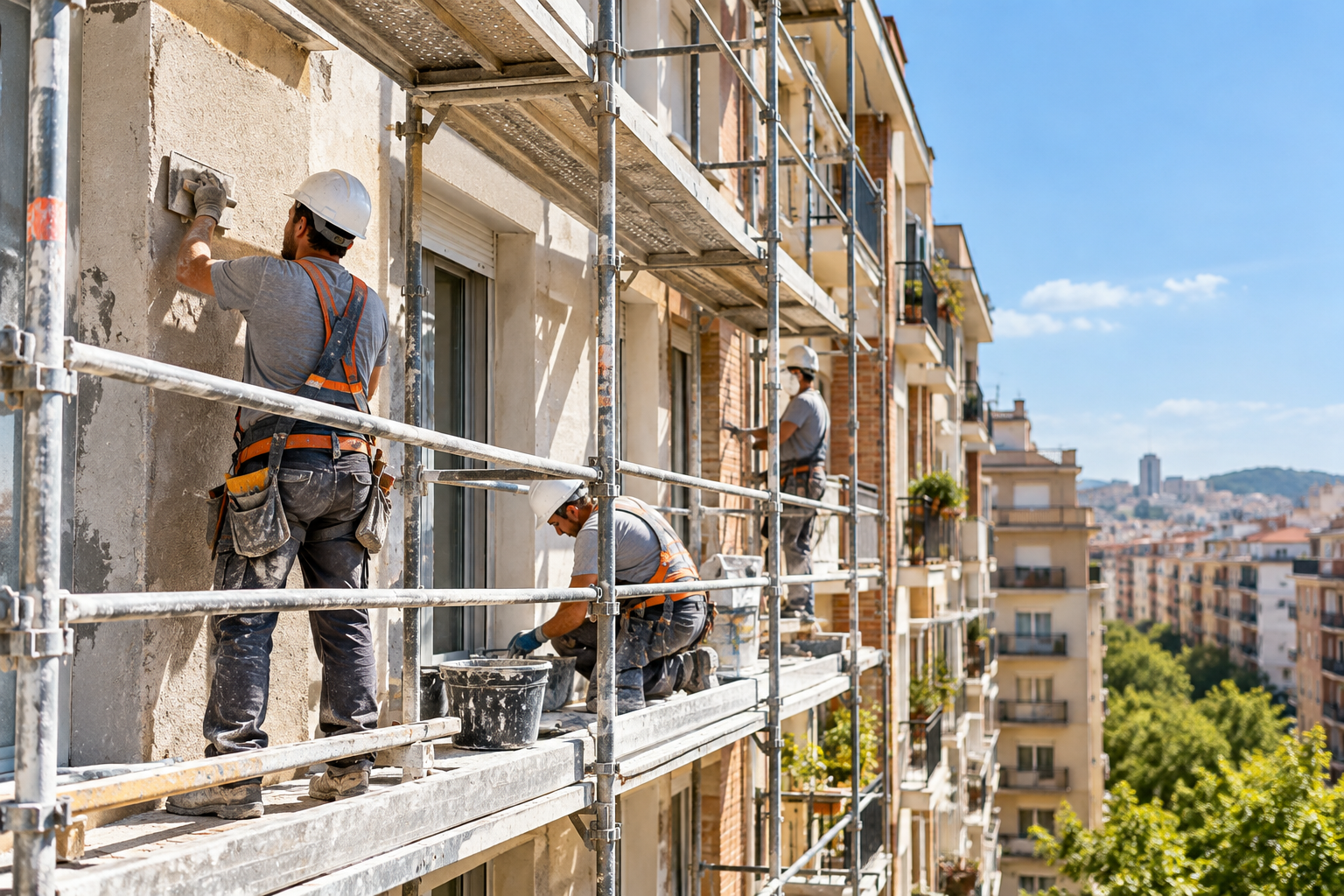
The Spanish housing market is experiencing a paradox that directly affects property managers and homeowners' associations: there is more need than ever to renovate, maintain, and rehabilitate buildings, but it is increasingly difficult to find someone to do it. The shortage of professionals in construction trades has become one of the factors most shaping the sector in 2026, with direct effects on execution timelines and the cost of home services. We analyze what is happening and what it means for those managing the day-to-day operations of a community.
A Sector with More Demand than Hands to Meet It
The sector's data is compelling. According to the industry association, construction companies still need around 700,000 skilled workers to meet their needs. This is not a temporary problem: it is already being referred to as a "structural problem" that is not a temporary difficulty for some companies, but affects the entire sector and reduces its capacity to respond to the country's construction needs.
The deficit is especially concentrated in the trades most used by homeowners' associations: the construction sector in Spain has 95,000 vacancies, mainly in trades such as plumbing, electricity, and carpentry. These are precisely the profiles required for preventive maintenance, urgent repairs, and small renovations that any manager handles on a recurring basis.
Why Are Qualified Trades Lacking?
Behind this tension is an underlying demographic problem. The lack of generational replacement and the aging workforce have led to a strong dependence on foreign labor, which already represents 17% of the total. This generational gap is noticeable throughout the sector's labor pyramid, where young profiles are scarce compared to a workforce nearing retirement without sufficient replacement.
Another factor is added to this: the construction model itself is changing. The sector's activity has seen six consecutive months of year-on-year declines in 2026, a decrease concentrated mainly in building construction, which suffers a 38% drop. While new construction slows down, the rehabilitation and maintenance of existing buildings gain relative weight as a driver of activity, adding pressure on the same trades that are already scarce. In fact, energy rehabilitation, housing demand, and European funds are driving the sector while the lack of generational replacement is the major challenge.
The Impact on Prices and Timelines for Communities
The combination of fewer hands and more demand has a direct consequence: the shortage of labor and high demand have caused a sustained increase in labor costs, with wages rising between 8% and 15% over the last two years in several communities. This wage increase, logical given the lack of available professionals, ultimately translates into the final budget of any community intervention, from plumbing repairs to comprehensive renovations of common areas.
In the specific case of Catalonia, renovation budgets already reflect this market tension. In Barcelona, for a medium-quality renovation, the budget ranges between 650 and 950 euros per square meter, meaning that renovating an 80 m² apartment can require an investment of between 52,000 and 76,000 euros, excluding VAT. Nationally, market references place the average price of a home renovation around 550 euros per square meter, with a usual range between 460 and 650 euros per square meter.
For a homeowners' association, this translates into something very practical: budgets take longer to arrive, start dates for work are extended, and reputable professionals have increasingly busy schedules. Planning ahead is no longer a recommendation but a management necessity.
What This Means for Building Maintenance in 2026
- Anticipation in Planning: request quotes and reserve dates months in advance, especially for major interventions.
- Realistic Budgets: incorporate labor cost increases into community forecasts, avoiding outdated line items.
- Diversify Trusted Suppliers: having several qualified professionals per specialty reduces the risk of being without service when an emergency arises.
- Prioritize Preventive Maintenance: in a market where getting an appointment is more difficult, avoiding major breakdowns saves time as well as money.
In this context, having a directory of verified professionals specialized in communities makes the difference between waiting weeks for a response or having direct access to available and trusted trades.
How to Adapt from the Daily Management of the Community
The shortage of qualified professionals will not be resolved overnight: sector data indicates that the mismatch between supply and demand will continue to shape the renovation and maintenance market in the coming years. For property managers and community presidents, the key is to anticipate: review maintenance schedules, update budgets to market reality, and maintain stable relationships with reliable suppliers instead of seeking professionals only when urgency arises.
If you manage a community and want to avoid delays and cost overruns resulting from this strained market, at ForConnect we connect property managers with qualified and verified professionals in plumbing, electricity, HVAC, renovations, and much more. Request a quote for your next intervention and stay ahead of a demand that continues to grow.