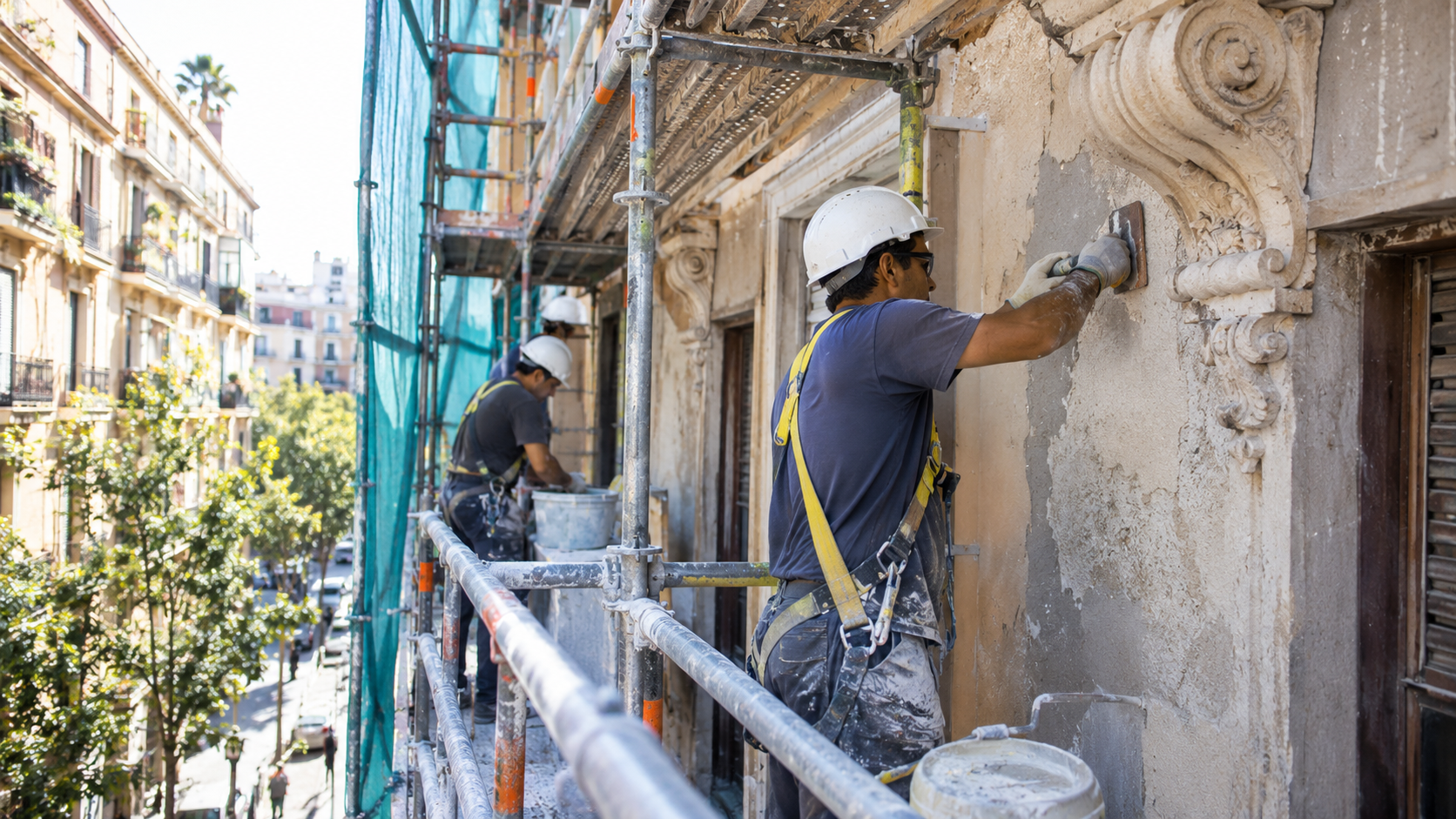
The Spanish real estate market is experiencing a moment of contrasts: housing prices continue to rise, the demand for renovations keeps growing, and at the same time, the sector is dragging a shortage of trade professionals that is beginning to affect timelines, budgets, and the very capacity of communities to maintain their buildings in good condition. Understanding this tension helps property managers and homeowners' associations to plan more realistically.
A Real Estate Market That Gives No Respite
In Catalonia, data from the first quarter of 2026 confirmed that the price escalation continues. The price per m² of housing in Catalonia registered a new increase during the first quarter, reaching its highest since the first quarter of 2009. In new housing, the average price has been 2,925 €/m², the highest in the series, with a quarterly rise of 3% and an annual increase of 8.3%. Short-term forecasts also do not point to a correction: the expert emphasizes that there are no elements pointing to a significant price correction in the short term, as long as the structural supply deficit persists and administrative deadlines remain long.
This increase in new housing prices pushes many homeowners to renovate instead of buying, and the demand clearly reflects this. 84% of Spanish consumers intend to carry out a renovation in their home, and 59.25% plan to do so this year. This trend is not new: already in 2025, the rehabilitation sector reached 1.9 million homes intervened in Spain, with three out of ten households making improvements in their homes. For homeowners' associations, this context translates into more facade, roof, and common installation rehabilitation projects competing for the same resources as individual renovations.
The Other Side of the Coin: A Lack of Skilled Hands
The problem is not just about prices, but about the actual capacity to execute the work. Estimates point to a deficit of nearly 700,000 bricklayers, a gap that threatens to halt key projects and further strain the housing market. And it's not a temporary hiring problem: Spanish construction added 60,000 jobs in the second quarter of 2026, reaching 1.637 million employed people, but this growth hides a loss of 100,400 skilled professionals in one year.
Employment indicators in the sector are even more revealing. According to a SEPE report, about 80% of available positions in construction are difficult to fill, 18.6% of vacancies remain permanently unfilled due to a lack of candidates, and only 2.1% are filled without issues. The generational shift is also one of the roots of the problem: more than 55% of construction workers are over 45 years old, and the incorporation of young people is insufficient for generational replacement.
The Most Strained Trades
Not all trades suffer equally from this shortage. Technical and installation profiles are the ones with the most difficulty finding replacements: trade associations estimate that about 70,000 electricians are missing and that at least 30% of installers will retire in ten years. This shortage is not exclusive to Spain: on a European scale, electricians and plumbers are among the occupations with the greatest shortage on the continent, making it even more challenging to attract talent from abroad.
In the Catalan case, the pressure is especially visible due to the volume of activity: there is a growing competition between companies to attract trade professionals, especially in communities like Madrid and Catalonia, where building activity is more intense. This translates, in practice, into longer waiting lists for quotes and executions, even for maintenance interventions that used to be resolved in days.
What This Means for Communities and Managers
The combination of high demand and a shortage of skilled labor has very concrete effects on the daily management of a homeowners' association:
- Increased Work Costs: construction costs have increased by 5.4% at the beginning of 2026 due, in part, to the shortage of personnel, which directly impacts special assessments and construction budgets.
- Longer Timelines: getting an appointment for an urgent repair or a major renovation requires planning much further in advance than a few years ago.
- Risk of Losing Quality for Price: the renovation sector faces high demand, but professionals complain that hiring is still marked by the search for the lowest budget, which can lead to poorly executed work if not chosen wisely.
- Difficulty Finding Trusted Specialists: electricians, plumbers, and HVAC installers are precisely the most scarce and in-demand profiles in communities.
How to Anticipate from the Community
In this scenario, planning and relationships with trusted professionals become more important than ever. Some practical recommendations for managers and homeowners' associations:
- Advance the hiring of foreseeable maintenance and renovations instead of waiting for urgency.
- Prioritize verified professionals with good references over the cheapest option without guarantees.
- Maintain stable relationships with trusted trades to ensure availability when unforeseen events arise.
- Compare several quotes, but also consider execution timelines and proven experience.
In this context, having a directory of verified professionals helps reduce uncertainty: it allows locating plumbers, electricians, locksmiths, or HVAC specialists with known track records, instead of competing for the same scarce resources without any prior reference.
Conclusion: Planning is the Best Defense
The shortage of trade professionals is not going to be resolved overnight, and it coexists with a real estate market where prices remain high and the demand for renovations remains strong. For homeowners' associations, the best strategy is to anticipate, maintain a realistic maintenance plan, and work with trusted professionals before urgency arises. If your community needs to resolve an issue, modernize installations, or plan a renovation, at ForConnect you can request a quote from verified professionals and thus avoid the bottlenecks that currently strain the sector.