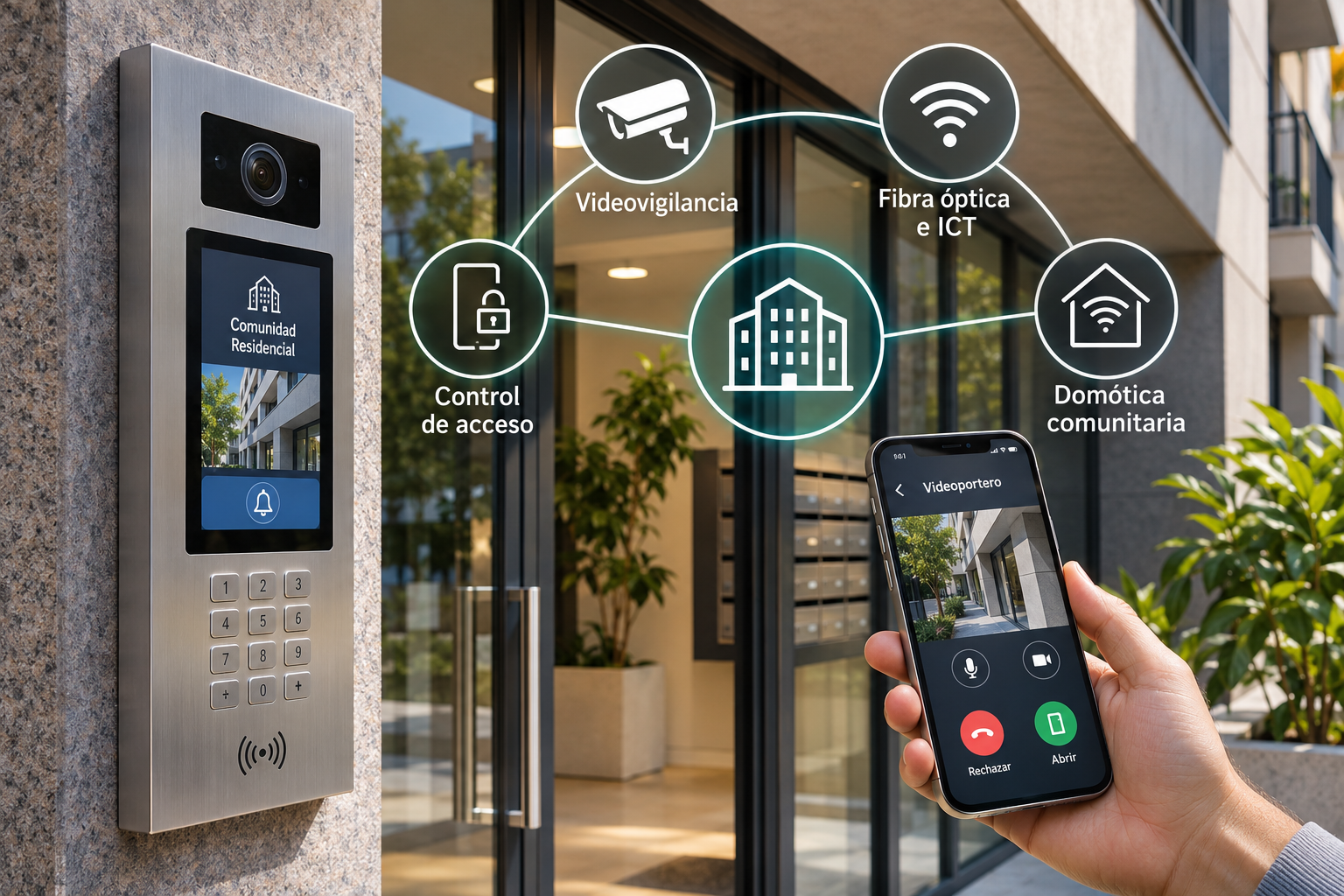
The security of a residential community is no longer measured solely by the quality of the building's lock. Today, smart intercoms, video surveillance, access control, and the telecommunications infrastructure that supports this entire ecosystem come into play. For property managers and community presidents, understanding how these pieces fit together is key before approving any investment in a board meeting.
Why Security and Telecommunications Go Hand in Hand
For years, each system was installed separately: one company installed the intercom, another the cameras, and the fiber optics were deployed by the operator without coordination with anyone. This fragmentation no longer makes sense. Modern buildings seek integrated solutions where access, image, and connectivity share the same technical base, facilitating maintenance, reducing medium-term costs, and improving the residents' experience.
Smart Intercoms: The Gateway to the Connected Community
The most visible change for residents is often the replacement of the traditional intercom with an IP video intercom. IP systems connect to the network and offer greater features: better resolution, NVR recording, integration with home automation systems, and advanced functions with a higher level of security, such as facial recognition.
In the Spanish market, the main manufacturers have consolidated ranges that combine mobile connectivity, sleek designs, and extreme ease of installation, even utilizing old wiring, allowing a building to be modernized without invasive work. An example of this trend is the new generation of panels that use 2-wire technology to leverage existing wiring in renovations but integrate features previously reserved for pure IP systems, such as built-in 4G connectivity that ensures call diversion and remote management even if the building's internet fails.
When choosing, the size of the community makes a difference: in buildings with up to twenty residences, typically built between 1990 and 2010 with two-wire installations, the most reasonable option is an IP module that adds an app without changing the wiring, while in communities of twenty to a hundred residences, IP systems over the network offer greater robustness, better image quality, and centralized management. Before deciding, it is advisable to compare quotes from several installation companies through the ForConnect professional directory, where you can filter specialists in telecommunications and security for buildings.
Fiber Optics in the Building: What the Community Needs to Know
The arrival of fiber optics in a building is not a technological whim, but almost a de facto obligation if the community wants to avoid constant complaints from owners. The regulations establish a clear procedure when an operator wants to deploy a network in a building that lacks common telecommunications infrastructure: the first operator intending to use the building's common elements for deployment must notify the community of owners in writing along with a descriptive report. From there, the installation cannot be carried out if, within a month of the notification, the community proves that no owner is interested in having that infrastructure, or if it opts to execute its own Common Telecommunications Infrastructure (ICT).
Beyond the administrative process, it is worth remembering that telecommunications infrastructures support smart buildings, improve energy efficiency and security, and must meet fire reaction and facade wiring organization requirements. In fact, a ministerial order in 2019 introduced significant changes in ICT regulations focused precisely on the fire reaction of cables installed inside residences and other common spaces. A manager who understands these requirements will avoid shoddy installations that later cause problems in the building's technical inspection.
Community Home Automation: When Security and Comfort Integrate
Home automation in communities is no longer limited to programming garage lighting or automating garden irrigation. More and more buildings are seeking unique platforms where the following converge:
- The video intercom and access control with card, code, or app.
- Video surveillance cameras in common areas.
- The opening of garage doors and gates.
- Incident management in elevators or lighting.
- Presence or energy consumption sensors in common areas.
Integrating these elements into a single management panel simplifies the day-to-day life of the property manager and reduces response times to breakdowns or security incidents. It also makes it easier to audit who accesses which area and when, something especially useful in communities with shared garages, storage rooms, or sports areas.
How to Approach the Project Without Errors
Before bringing a modernization proposal to the owners' meeting, several points should be clear:
- Define what problem you want to solve: security, comfort, maintenance savings, or all at once?
- Review the condition of the existing wiring to know if it is feasible to use it or if new work is needed.
- Request comparable quotes from several companies specialized in building security and telecommunications.
- Ensure that the installation complies with data protection regulations if it includes cameras or facial recognition.
- Plan for subsequent maintenance, not just the initial installation.
At ForConnect, we help managers and communities find trusted professionals for these types of projects, from installing an IP video intercom to deploying fiber optics or integrating community home automation. If your community is considering taking this step, you can request a quote through ForConnect and compare proposals without obligation.
Modernizing a building's security and telecommunications is an investment that is noticeable both in the residents' peace of mind and in the property's value. Taking the step with clear information and the right professionals makes the difference between a successful project and a poorly planned expense.