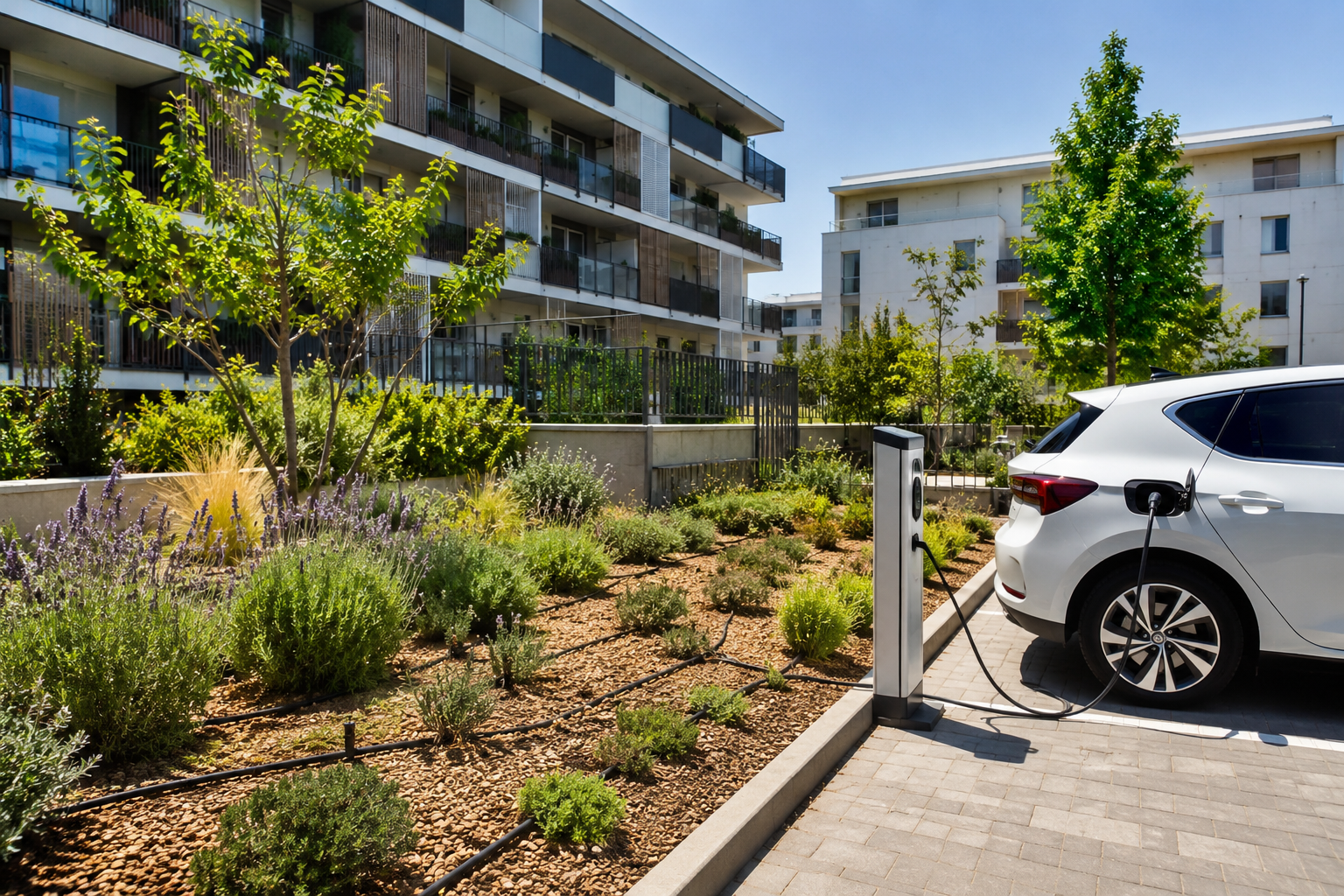
Sustainability has ceased to be an added value to become a management necessity in any homeowners' association. Among the drought restrictions affecting different areas of the country, the digitalization of waste collection, and the unstoppable growth of electric cars, water saving in community associations has become one of the central axes of any building sustainability plan. In this article, we review four fronts that every community should have in their roadmap: water, leaks, waste, and electric mobility.
Drought Forces Rethinking Water Consumption in Communities
Summer once again highlights water management. Various areas of the country face water restrictions after a drought pre-alert was declared, with municipalities already interrupting supply in some localities. In the Balearic Islands, for example, the use of potable water from the municipal network for watering lawns and plants in residential gardens, as well as cleaning vehicles with hoses, has been prohibited, allowing only cleaning with buckets and cloths. These increasingly frequent measures anticipate a scenario where communities will have to prioritize water saving in common areas, gardens, and community pools as part of their regular management, not just as a temporary response to a seasonal crisis.
Water Saving in Community Associations: Measures That Work
Beyond temporary restrictions, there are structural measures that any community can progressively implement:
Install low-consumption devices (aerators, timed faucets) in common areas.
Review and optimize the garden irrigation system, replacing grass with low-water-consumption species.
Avoid unnecessary emptying of the community pool and improve its filtration system.
Reuse water for cleaning common areas when technically feasible.
These actions have a direct impact both on the water bill and on the building's sustainability in the medium
term, and usually require the intervention of professionals specialized in plumbing and water efficiency.
Leak Detection in the Building: Technology Makes the Difference
One of the biggest sources of invisible waste in any building is undetected leaks. In Spain, it is estimated that about 23% of the water introduced into urban networks does not reach the end-user, as it is lost in real or apparent leaks before being accounted for. At the community level, this percentage translates into old pipes, hidden manholes, or community installations that drip for months without anyone noticing until the bill arrives.
The detection of water leaks in buildings has evolved thanks to sensorization: acoustic sensors can identify and locate leaks in pipes with great precision, which not only saves water but also significantly reduces repair costs. These systems allow remote monitoring, especially useful for building managers or owners of multiple properties, with automatic alerts that anticipate the problem before it becomes a structural failure or severe dampness in lower floors.
For a community, investing in early leak detection is not just a matter of economic savings but also of environmental responsibility and disaster prevention. Having plumbing professionals specialized in these types of installations makes the difference between a one-time repair and a real water maintenance plan.
Waste Management: Towards Smarter Containers
The other major sustainability challenge in the building relates to waste. Several municipalities are deploying more demanding selective collection systems, especially for the organic fraction. These new containers aim to encourage the recycling of organic matter and improve the quality of selective collection, in a context where the organic fraction represents about 35% of the waste that was previously treated as residual. In some municipalities, closed containers are already being tested, which must be opened with a card and are dedicated to organic waste to encourage selection over other waste.
For communities, this implies two things: on one hand, adapting common spaces intended for waste (trash rooms, separation points) to new municipal requirements; on the other hand, informing and sensitizing residents about proper separation at the source, especially of the organic fraction, which increasingly has more regulatory and economic weight in the building's waste bill.
Electric Mobility: What the Community Should Know Before Installing a Charging Point
The installation of electric car charging points in the community continues to grow, and it is advisable to be clear about the legal framework before undertaking an individual or collective installation. The Horizontal Property Law, in its article 17.5, recognizes a specific right of the owner with an electric vehicle: it is enough to notify the community in advance of the installation of the charging point in their individual space. This means that, for a private installation connected to the individual meter, the process is reduced to a simple procedure: notify the community in writing, without the need to submit it to a vote in the meeting.
In terms of aid, it is advisable to review the current conditions each year, as they are updated frequently: there is a 15% deduction in personal income tax for the installation of a charging point, subject to the deadlines and requirements set by the current tax regulations at any given time. For collective installations in community garages, with several affected spaces, it is advisable to plan the available power, cost distribution, and coordination with a specialized installer who presents the corresponding technical documentation to the community.
An Integral Sustainability Plan, Not Isolated Measures
Water saving, leak detection, waste management, and electric mobility are not independent initiatives: they are part of the same building sustainability plan that reduces costs, improves the property's value, and responds to a growing demand from owners and managers. The key is to address them progressively, prioritizing what generates the most savings and impact with the least initial investment, such as leak detection or irrigation optimization, before moving on to larger-scale projects like collective electric charging.
If your community wants to take the next step, in the ForConnect professional directory you can find trusted specialists in plumbing, energy efficiency, and electrical installations for your building. And if you already know what you need, you can request a quote and compare proposals tailored to your community without obligation.