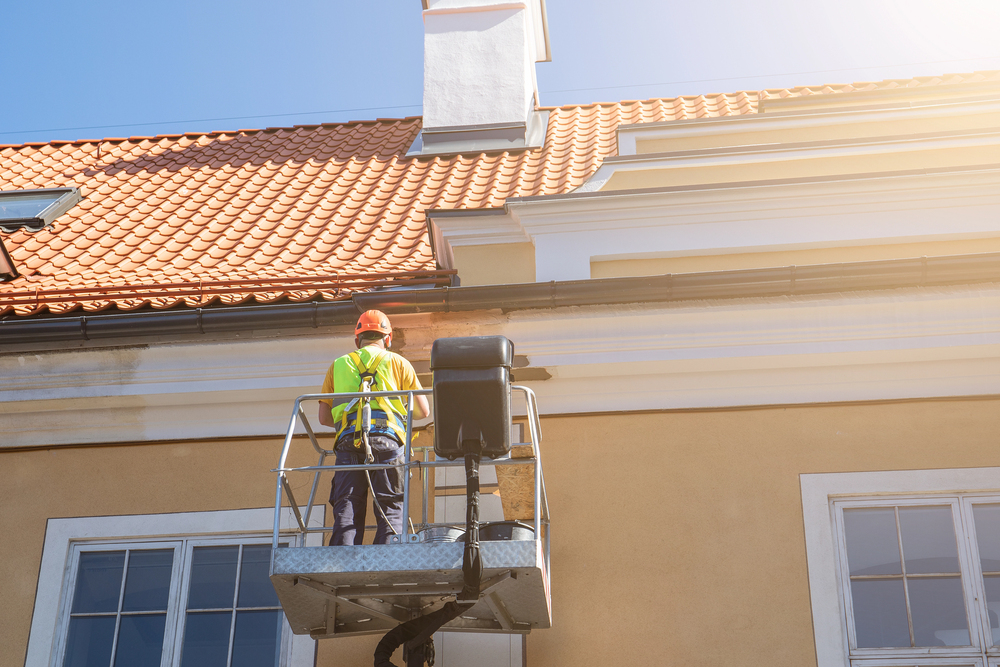
A crack, an area at risk of detachment, a leak, or a deteriorated downspout may require a homeowner community to act on a facade. However, this does not necessarily mean that all interventions require scaffolding around the building.
Vertical work in homeowner communities allows access to certain hard-to-reach areas using rope positioning techniques. They are especially interesting when the action is localized, but they are not an automatic alternative to scaffolding: the choice of access system must respond to the characteristics and risks of each intervention.
What exactly is vertical work?
The National Institute for Occupational Safety and Health (INSST) defines vertical work as access and positioning techniques using ropes to perform temporary work at height. The system has a working line and a safety line fixed independently, along with the necessary equipment and devices. INSST Portal
This system allows the professional to reach directly the point of the building where work is needed.
This is especially useful in interior courtyards, party walls, facades, roofs, and other areas where conventional access can be complex.
When can vertical work be used in a community?
Spanish regulations establish an important consideration: access and positioning techniques using ropes should be limited to situations where the risk assessment indicates that the work can be executed safely and where the use of other safer work equipment is not justified. INSST Portal
Therefore, the question should not simply be posed as “scaffolding or ropes: which is cheaper?”.
First, it is necessary to determine what intervention is to be carried out and which system allows it to be executed correctly and with the necessary safety guarantees.
The same INSST points out examples where vertical techniques may be suitable, such as the repair of water pipes in light wells, the repair of downspouts, or preventive facade sanitation. INSST Portal
Localized facade repairs
When the problem is concentrated in certain points, access via ropes can allow direct reach to the affected area.
This is the case, for example, of certain cracks, deteriorated elements, or areas that need sanitation.
However, before repairing, it is advisable to identify the origin of the pathology. Covering a crack without knowing why it occurred may solve the visual problem but not necessarily the cause.
Waterproofing
Leaks are another common problem in buildings.
Depending on their location, a specialized company can access complicated points on facades or other exterior elements and carry out the corresponding waterproofing work.
Here again, a good diagnosis is essential: the humidity appearing inside a home does not always originate just at the nearest exterior point.
Downspouts and interior courtyards
Light wells particularly exemplify the usefulness of this system.
Installing scaffolding in certain interior courtyards can be complex due to the building's configuration. Vertical techniques can facilitate access to downspouts, ducts, and interior walls, provided that the risk assessment determines they are suitable.
In fact, the technical documentation of the INSST expressly identifies the repair of wastewater downspouts and ducts in light wells among the situations where these techniques may be justified. INSST Portal
Vertical work or scaffolding: which is better?
There is no universal answer.
A specific intervention in a particular area of a facade presents very different needs from a comprehensive rehabilitation affecting a large surface of the building.
Vertical work can be especially interesting when there are localized intervention points or hard-to-reach areas. In contrast, extensive work may require other access or protection systems.
Therefore, a community should not decide the system solely based on the initial budget.
The appropriate question is: which system allows this work to be executed correctly and its risks to be controlled?
Safety is the determining factor
Working suspended several meters above ground requires specific procedures, equipment, and training.
Royal Decree 2177/2004 regulates the minimum safety and health provisions related to equipment used in temporary work at height and specifically introduces access and positioning techniques using ropes. BOE
The INSST explains that the rope access system uses two lines secured independently: a working line and a safety line. The professional is connected to both via the harness and corresponding devices. INSST Portal
It is also essential to correctly study the anchors, fixation points, support resistance, and rope protection against possible friction or edges. INSST Portal
For a community administrator or president, this means that price cannot be the only criterion for comparing quotes.
What should the community review before hiring?
Before accepting a proposal, it is advisable to be clear about the scope of the intervention: which areas will be repaired, what pathology has been detected, which materials will be used, what access system is planned, and what exactly the budget includes.
It is also convenient to check the guarantees, the corresponding documentation, and the preventive measures planned for the action.
Two seemingly similar quotes may be proposing very different technical solutions.
Therefore, it is preferable to compare scope, methodology, and guarantees, and not just look at the final figure.
The vision of Ciutat Vertical
This type of intervention is precisely the area of specialization of Ciutat Vertical, a company that declares more than 15 years of experience in height work and painting. ciutatvertical
Among the services offered are height work, facade rehabilitation, waterproofing, lifelines and fall arrest systems, as well as exterior and interior painting, varnishes, and stuccoes. ciutatvertical
The combination of these specialties allows addressing common needs of buildings where access is an important part of the intervention.
Ciutat Vertical and ForConnect
Ciutat Vertical is part of the ecosystem of professionals of ForConnect, which connects property managers, communities, and individuals with companies specialized in different building-related services.
In the case of Ciutat Vertical, its specialization focuses especially on vertical work, facade rehabilitation, waterproofing, and painting, with services oriented towards the Balearic Islands according to the information published by the company itself. ciutatvertical
When a community detects cracks, leaks, coating deterioration, or problems in hard-to-reach areas, the first step should not be to decide whether scaffolding is needed, but to obtain a correct diagnosis and determine the appropriate way to intervene.
If your community needs a specialized company in rehabilitation or vertical work, at ForConnect you can find verified professionals and request advice or a quote.