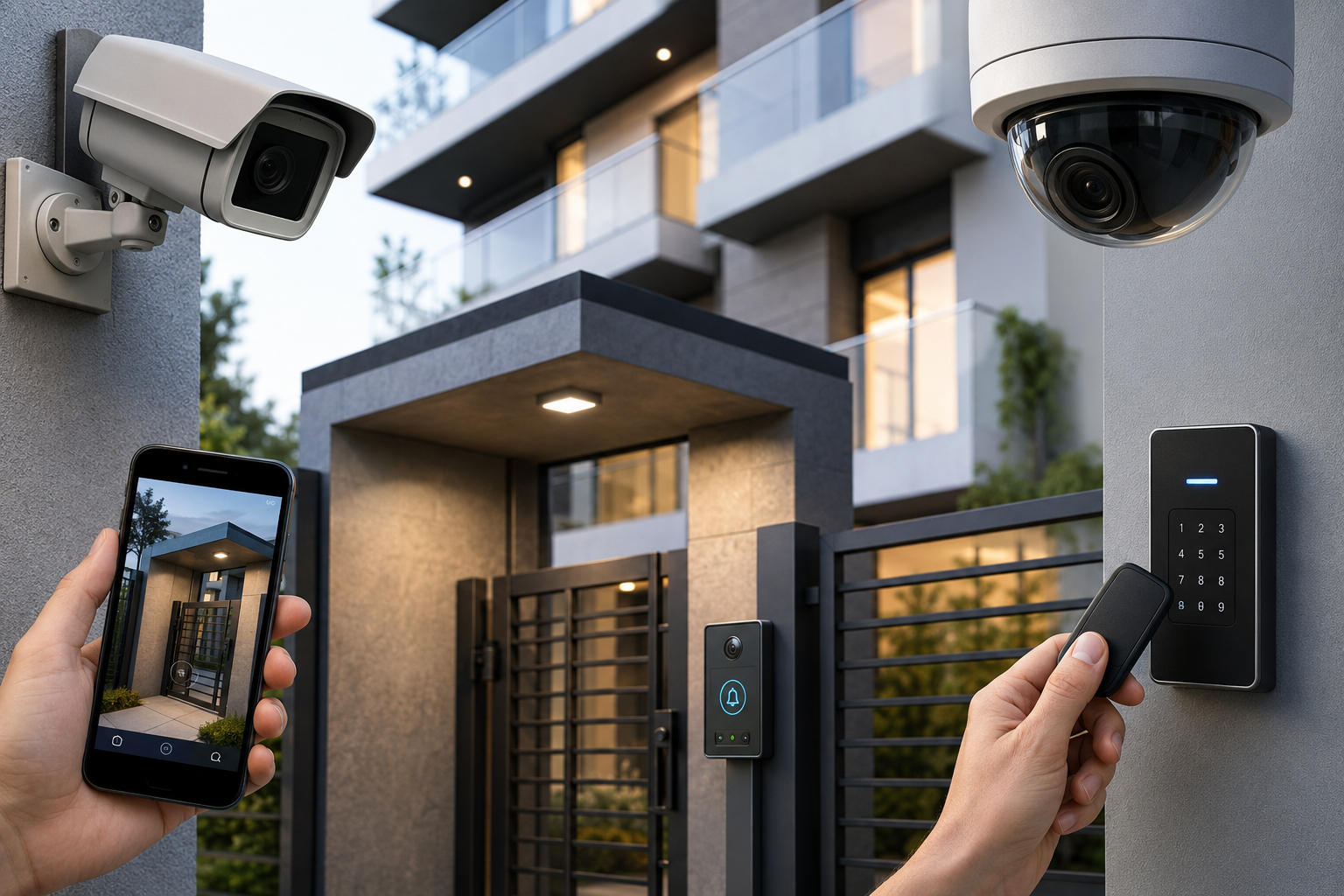
More and more residential communities are installing cameras in garages, entrances, and common areas to prevent theft, vandalism, or squatting. However, before approving any system, it's important to clearly understand the video surveillance community regulations, because installing cameras without complying with data protection legislation can lead to significant financial penalties and the obligation to remove the system. In this article, we review what the law requires, how recordings should be managed, and how smart intercoms, access control, and home automation fit into this ecosystem.
What the video surveillance regulations for residential communities require
The installation of cameras in common areas is not a decision that can be made by the president alone or a small group of owners. The installation of surveillance cameras in the community is considered a common security measure, which means it CANNOT be decided unilaterally by the president or a small group of neighbors. In fact, in residential communities, cameras can only be installed in common areas with the agreement of the board, respecting the majority required by horizontal property regulations for such agreements.
Additionally, images captured by security cameras are considered personal data, and the AEPD considers that even a disconnected camera requires compliance with the regulations, as passersby cannot verify if it is operational. Therefore, the installation must be planned from the outset with data protection criteria, not just physical security. The main obligations include:
Prior agreement of the board of owners, following the required majority.
Hiring an installation company that guarantees technical and legal compliance.
Visible signage informing of the existence of the cameras.
A maximum retention period for recordings.
Record of Processing Activities when applicable.
In this regard, video surveillance in communities in Spain is regulated by the GDPR, the LOPDGDD, and the AEPD's criteria, with obligations that include board agreement, authorized installation company, visible signage, maximum retention of 30 days, and Record of Processing Activities. If the property manager directly manages the system, they act as the data processor and must sign a data processing agreement with the community.
Signage, image retention, and who can view them
One of the most common mistakes is not properly signaling the video-surveilled area. The regulations require placing visible signs before entering the video-surveilled area, which must identify the data processing controller and indicate how to exercise access, deletion, or restriction rights. Many communities use outdated or incomplete notices, which is one of the most frequent causes of sanctions.
Regarding image retention, recordings can be kept for a maximum of 30 days, after which they must be automatically deleted unless linked to a police or judicial investigation. Not all neighbors can freely access the recordings: access to images must be limited to expressly authorized persons, and it is not proportional for all neighbors to be able to view them, so it is advisable to designate one or two responsible persons with protected credentials. In fact, a neighbor does not have the right to view recordings for mere personal interest.
Penalties for non-compliance with the regulations
The cost of non-compliance can be high. According to current sanctioning criteria, non-compliance can result in fines ranging from €900 to €300,000, depending on the severity. More specifically, minor infractions, such as the absence of signage or retaining images for more than 30 days, can reach €40,000, while serious infractions, such as cameras systematically capturing public roads or foreign properties, can reach €300,000. This is another reason why any installation should be planned with a professional company that knows the regulations and not just the technical part.
Smart intercoms and access control: the building's digital gateway
Beyond cameras, access control in buildings has evolved significantly. Technology and new communication systems have enabled the leap from the traditional intercom to new IP video intercoms, which become key elements for building access control with high security and efficiency guarantees. These systems allow identifying visitors from a mobile phone, opening the door remotely, or integrating the intercom with other home devices.
In the realm of access control in general, the trend points towards more flexible and connected solutions. The access control as a service model is gaining strength because it allows remote management, automatic updates, and operational cost reduction, with hybrid implementations that combine local and cloud control. Translated to a residential community, this means virtual keys, temporary codes for visitors or suppliers, and access logs that facilitate incident management without relying on physical keys that are lost or duplicated without control.
Home automation and fiber optics: the foundation of a truly connected building
Neither video surveillance nor smart access control works without an adequate telecommunications infrastructure. Having quality fiber optics in the building is what allows cameras to record in the cloud, IP intercoms to function without interruptions, and common area home automation — lighting, irrigation, garage access control — to respond in real time. When a community considers renewing its security system, it is advisable to also review the state of the building's telecommunications infrastructure, as outdated conduits or wiring can greatly limit the performance of new equipment.
Therefore, before approving any security and home automation project, it is advisable to request quotes from several specialized professionals who assess both the legal and technical aspects. In ForConnect's professional directory, you will find verified installers of video surveillance, access control, and telecommunications adapted to the needs of residential communities.
How to take the next step with guarantees
Modernizing a community's security — cameras, smart intercoms, access control, and home automation — is an investment that improves residents' peace of mind, but it only makes sense if done in compliance with regulations from the project design: board agreement, signage, retention periods, and restricted access to recordings. Having professionals who understand both the technical and legal parts avoids future problems and sanctions.
If your community is considering installing or renewing its video surveillance, access control, or home automation system, you can request a quote through ForConnect and compare proposals from specialized installers who know the regulations applicable to residential communities.