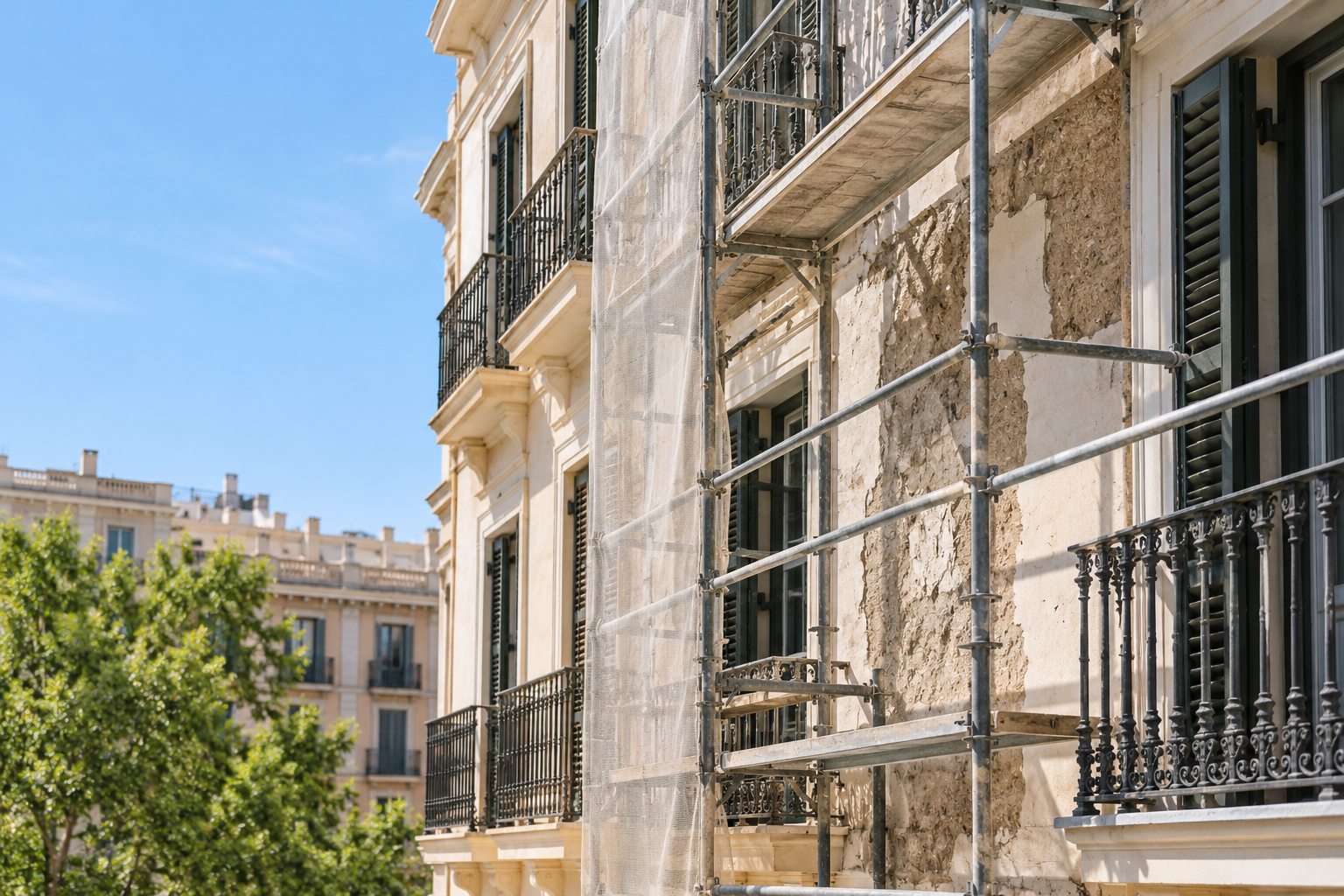
A new crack, a humidity stain that reappears after each rain episode, or small fragments of cladding starting to detach may seem like isolated problems. However, a facade is constantly exposed to humidity, wind, temperature changes, and other agents that, over the years, can degrade the building's materials.
For a homeowners' association, addressing the facade is not just an aesthetic issue. Timely detection of certain pathologies allows for determining whether a localized repair is sufficient or if a more comprehensive facade rehabilitation is necessary.
In Mallorca, where environmental conditions and outdoor exposure are part of daily life for buildings, specialized companies like FJC98 Revestimientos y Edificaciones work on both facade rehabilitation and structural works. This combination is particularly relevant when determining the true extent of deterioration.
What signals indicate that a facade needs a review?
Not all defects have the same importance. A superficial alteration of the paint is not comparable to a crack that evolves, persistent infiltration, or the detachment of a part of the cladding.
Among the signs a community should monitor are new or enlarging cracks, detachments, recurring humidity, infiltrations into the interior of homes, visible corrosion of metal elements, or any deformation that did not exist before.
The presence of any of these signs does not automatically mean the building has a structural problem. That's why it's important not to make diagnoses based solely on the exterior appearance.
Before deciding how to repair a facade, it's essential to know what is causing the deterioration.
Does a crack in the facade mean there is a structural problem?
Not necessarily.
Cracks and fissures can have very different origins. Some only affect the exterior cladding, while others may be related to building movements or construction elements that require deeper analysis.
The shape, width, location, and especially the evolution of the crack can provide information about the problem. But determining its cause and severity requires proper assessment.
Therefore, when faced with a crack that appears suddenly, evolves, or is accompanied by other pathologies, the community should avoid merely covering it without knowing its origin.
The problem of only repairing what is visible
One of the most common mistakes in building maintenance is addressing the symptom rather than the cause.
Covering a crack, repainting an area affected by humidity, or replacing a deteriorated piece can temporarily improve the facade's appearance. But if the problem's origin persists, the pathology is likely to reappear.
A clear example is infiltrations. Painting over a humidity stain may hide it for a while, but it won't solve an ongoing water ingress affecting the exterior closure.
This way of chaining small repairs can lead the community to incur several costs without definitively resolving the problem.
A good rehabilitation, therefore, should start with a diagnosis of the facade's actual condition.
When do we move from a repair to a facade rehabilitation?
The main difference lies in the scope of the intervention.
A punctual repair aims to solve a specific and localized issue. In contrast, a rehabilitation has a more global vision and seeks to restore adequate conditions of conservation, safety, and functionality of the facade.
If a community detects a very specific defect, a localized intervention may be sufficient. But when pathologies appear at different points, recur after being repaired, or there is generalized degradation of claddings and other elements, it makes sense to consider a more comprehensive action.
The decision should not be made simply by comparing the cost of a repair with that of a rehabilitation. It's also necessary to assess what is being solved with each proposal and how long this solution is expected to be effective.
What should a well-planned rehabilitation include?
Each building is different. Age, materials used, orientation, environmental exposure, and previous interventions condition the current state of the facade.
Therefore, the first step is to identify the pathologies and determine their causes. Based on this information, necessary actions, suitable materials, auxiliary means, safety measures, and work planning can be defined.
It's also important for budgets to be detailed.
For a property manager or homeowners' board, comparing only the final amount of three budgets can be misleading. One company may propose a superficial repair while another includes the removal of deteriorated elements, treatment of the support, and subsequent replacement.
If the scope of the work is not comparable, neither are the prices.
And if the deterioration affects structural elements?
This is where diagnosis becomes even more important.
When visible defects may be related to structural or more significant construction elements, a simple cosmetic action becomes meaningless.
The priority should be to determine what is happening, the extent of the impact, and what intervention is appropriate.
This distinction is especially important for homeowners' associations because it allows them to separate two very different situations: a facade that needs maintenance and an intervention that may require deeper work on the building.
The vision of FJC98: rehabilitation and structural works
FJC98 Revestimientos y Edificaciones specializes in construction and rehabilitation in Mallorca and includes facade rehabilitation, structural works, and renovations among its main services.
The company itself points out that the continued deterioration of a building's exterior elements may eventually require deeper interventions. Hence, facade rehabilitation and structural works are two of its areas of activity.
FJC98 declares professional experience since 1998 and operates mainly in Mallorca, with a location in Palma.
The combination of these specialties is particularly useful in projects where visible defects require determining whether the problem is limited to the exterior cladding or if other building elements need to be studied.
How should a community act when the first signs appear?
Waiting for the problem to become evident usually reduces the available options.
When cracks, detachments, recurring infiltrations, or significant changes in the building's exterior condition appear, it is advisable to document them and request a professional assessment.
Taking periodic photographs can be useful to check if a crack evolves. It is also advisable to keep reports, budgets, and documentation of previous interventions. The maintenance history helps professionals understand what has been done and whether a particular pathology had appeared before.
With a clear diagnosis, the administrator can request comparable budgets and present the homeowners' board with options based on the building's actual condition.
The goal should not be simply to repair what is visible, but to prevent a small pathology from becoming a more complex and costly intervention.
FJC98 and ForConnect
FJC98 Revestimientos y Edificaciones is part of the ForConnect ecosystem of professionals and specializes in construction and rehabilitation in Mallorca, offering facade rehabilitation, structural works, and renovation services.
The incorporation of companies specialized in different fields allows property managers, homeowners' associations, and individuals to find professionals according to the specific needs of each building.
If your community needs to assess a facade rehabilitation, a renovation, or an intervention on the building, at ForConnect you can find specialized professionals and request advice or a quote.