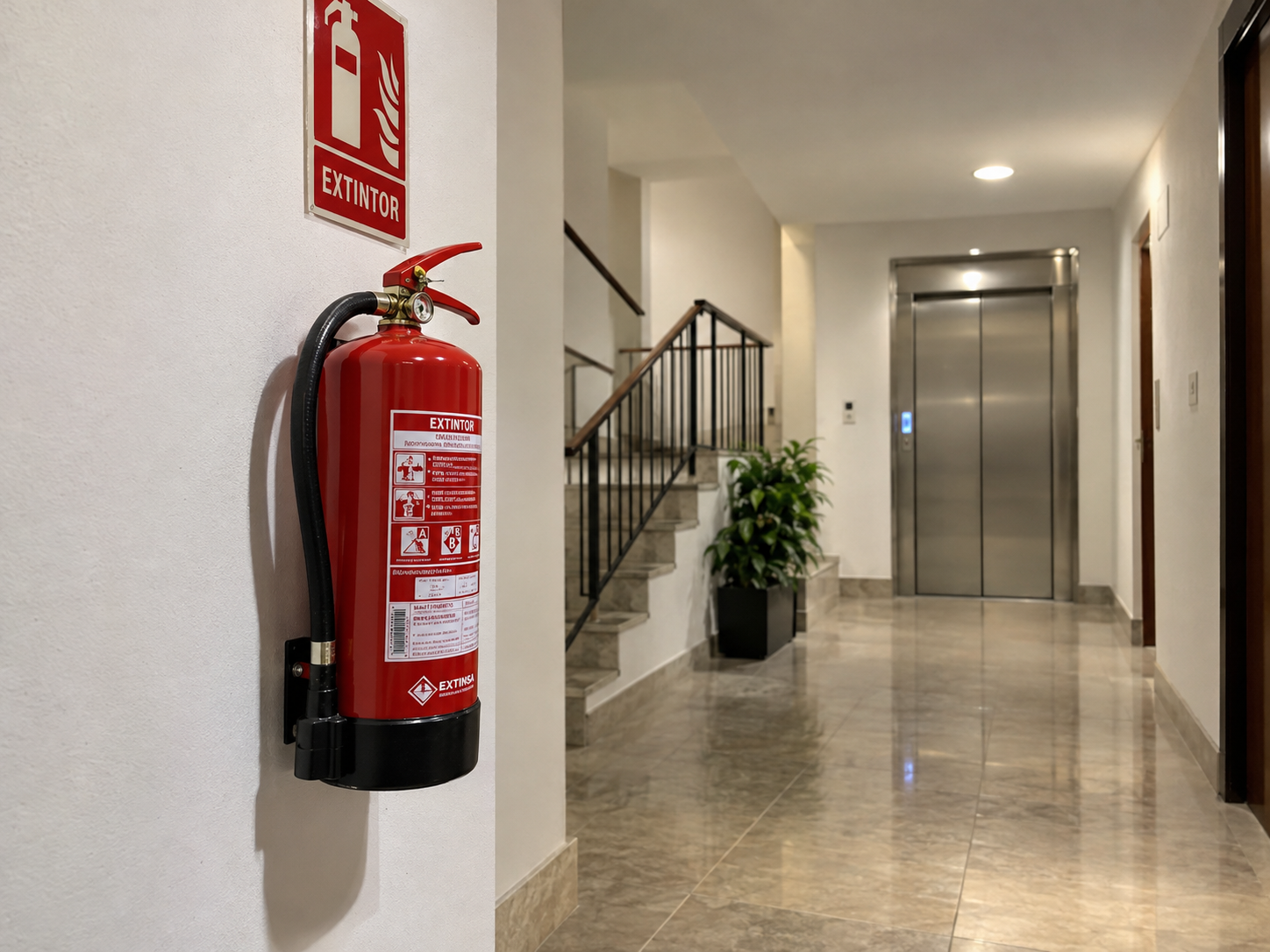
Fire safety is one of the most important responsibilities in managing a homeowner community. However, attention is often only paid to fire extinguishers, equipped fire hose reels, or detection systems when it's time for an inspection or an issue is detected.
Fire safety maintenance in homeowner communities is not just about ensuring that the equipment is installed. It also involves verifying their operation, respecting inspection deadlines, and ensuring that the installations comply with applicable regulations.
In Catalonia, specialized companies like EXTINSA offer installation, maintenance, and technical advisory services to help property managers and communities manage these obligations.
What regulations govern fire protection in communities?
The main state regulation is Royal Decree 513/2017, which approves the Fire Protection Systems Regulation (RIPCI).
This regulation establishes the conditions that active fire protection equipment must meet, as well as maintenance operations, inspections, and requirements applicable to installation and maintenance companies.
The regulation has been subsequently modified, among other norms, by Royal Decree 164/2025. Therefore, it is important to consult the consolidated version and take into account the corresponding transitional provisions.
Additionally, the Technical Building Code, especially the Basic Document on Fire Safety (DB-SI), establishes safety requirements that may determine which systems must be installed in a building.
Do all communities need the same systems?
No. The required installations depend on factors such as the building's age, evacuation height, uses, garage characteristics, and the regulations applicable at the time of construction or renovation.
Therefore, before installing new equipment or modifying existing ones, it is advisable to review the building's technical documentation and consult a specialized company.
How often should fire extinguishers and fire safety systems be checked?
One of the most common questions among property managers is the frequency of inspections.
The RIPCI establishes different maintenance operations depending on the type of equipment. Not all checks have the same frequency nor must they be executed by the same professional.
Quarterly inspections
Quarterly checks allow for the identification of obvious problems before they become a risk situation.
For example, it can be checked that fire extinguishers remain in their designated place, are accessible, and do not show visible damage.
Certain operations can be performed by the owner or user of the installation, provided that regulatory requirements are respected and properly documented.
Annual maintenance
Annual maintenance includes more specific technical checks.
In the case of fire extinguishers, the elements and conditions established by regulation are reviewed to ensure that the equipment remains in suitable conditions for use.
These operations must be carried out by personnel from an authorized maintenance company or in the specific cases admitted by the regulation.
Periodic tests every five years
Some equipment requires additional tests, such as pressure tests for fire extinguishers, when applicable according to pressure equipment regulations.
It is important not to confuse these operations with a simple visual inspection nor to assume that all equipment has the same lifespan.
Which fire safety systems should be checked in a building?
The fire protection of a community can include different installations, each with a specific function.
Portable fire extinguishers
Fire extinguishers allow action on a fire outbreak when conditions are safe and the person knows how to operate them.
They must be correctly located, signposted, and accessible. It is also important to use the appropriate type of extinguisher for the risks in each area.
Equipped fire hose reels (BIE)
BIE are fixed systems that provide water to intervene in the event of a fire. They can be found in certain parking lots and other building spaces that require this protection.
Their maintenance includes checks on the installation elements and periodic tests established by regulation.
Detection and alarm systems
Detectors and alarms allow the identification of risk situations and alert occupants.
Maintenance may include checks on detectors, control panels, power supplies, alarms, and other components, depending on the system's characteristics.
Emergency lighting and signage
Emergency lighting and evacuation signs are also essential elements of building safety.
It should be noted that emergency lighting installations are subject to the corresponding technical provisions, including applicable electrical regulations.
What are common errors in fire safety maintenance?
A community may have all the planned equipment and still present significant deficiencies.
Among the errors to avoid are the lack of follow-up on inspections, incomplete documentation, equipment blocked by objects, or detected incidents that are not corrected.
It is also common that, after a renovation, the distribution of a space is modified without checking if this affects the location of equipment or evacuation conditions.
Another error is considering that annual maintenance replaces all other checks. In reality, quarterly, annual, and periodic operations are complementary when they are required.
To avoid these problems, it is advisable to have an updated inventory of installed systems and a maintenance schedule.
What role does the property manager play?
The property manager plays an important role in coordinating maintenance and monitoring incidents affecting common elements.
Among their usual tasks are planning inspections, coordinating professional visits, managing budgets, and communicating necessary actions to the community.
It is also important to keep records and maintenance reports. The RIPCI requires that records of the corresponding operations be kept available to the Administration for at least five years from their issuance.
Organized document management facilitates incident follow-up and helps to verify the actions taken.
EXTINSA's vision: maintenance and technical advice
Fire protection requires a combination of regulatory knowledge, technical experience, and continuous monitoring.
EXTINSA is a company specialized in fire protection, low voltage, and engineering, with over 40 years of declared experience in the sector.
Among its services are the maintenance of fire extinguishers, equipped fire hose reels, detection and alarm systems, as well as other fire protection installations.
One of its distinguishing elements is that it has its own engineering department, which is involved in projects, technical documentation, adaptations, and legalizations of installations.
The company also offers periodic maintenance and regulatory advisory services specifically aimed at property managers and homeowner communities.
This approach allows addressing both ordinary maintenance and technical needs that may arise when an installation presents deficiencies.
EXTINSA and ForConnect: specialized professionals for communities
Managing fire safety requires professionals who know the installations, maintenance procedures, and obligations applicable to each building.
EXTINSA is part of the collaborating companies of ForConnect and offers specialized fire protection and low voltage services in Catalonia.
Through ForConnect, property managers and homeowner communities can connect with specialized professionals to manage maintenance, repair, and adaptation of installations.
If your community needs to check fire extinguishers, maintain fire safety systems, or resolve deficiencies in an installation, at ForConnect you can find verified professionals and request a quote tailored to the building's needs.